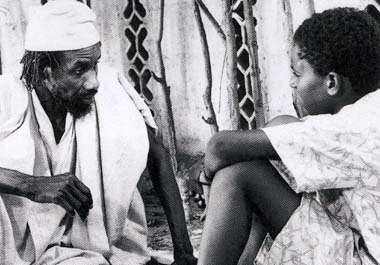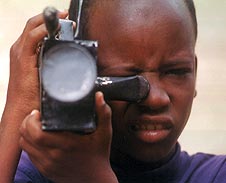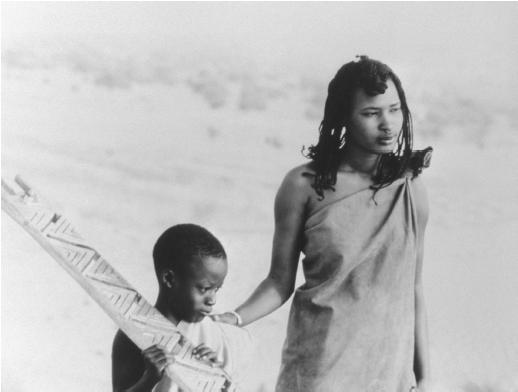
Yeelen (1987, Mali) directed by Souleymane Cissé
The visual patterning in Souleymane Cissé's film Yeelen reinforces the coming of age, journey motif and the parallel structure of the myth. Nianankoro’s mother sends him on a journey in which he travels from childhood to adulthood and must struggle against his father to find his own destiny. The struggle against the father counters the reformative new with the corrupted older tradition.
The visual patterning in Souleymane Cissé's film Yeelen reinforces the coming of age, journey motif and the parallel structure of the myth. Nianankoro’s mother sends him on a journey in which he travels from childhood to adulthood and must struggle against his father to find his own destiny. The struggle against the father counters the reformative new with the corrupted older tradition.
While Yeelen tells the story of Nianankoro’s journey from “childhood” to “adulthood,” from mother to wife, the pursuit and the chant of the father is a motif that stitches together Nianankoro’s journey. The father travels together with his two slaves and his post, seemingly driven by an anxiety that Nianankoro and his mother are trying to change tradition. And if tradition is defined as secretive purity, as Nianankoro’s (good) uncle implies when he explains that his twin blinded him when he asked him to “reveal secrets so that all might benefit,” then Nianankoro’s father has cause for worry. Although Nianankoro’s (bad) uncle disrespectfully dismisses the Peul king as a “little Peul” apparently because of their inability to do magic, the Bambara “nation” survives through Nianankoro’s marriage with the Peul woman. And at the end it is the Peul woman who is left to pass on the story of the “Bambara” nation to her son. Nianankoro penitently offers his life to the Peul king because he had “broken our laws” by sleeping with the king’s young barren wife; however, during the previous scene in which this sin is implied, the lovers seem lost in a trance comparable to that that the old men go through during their ritual. The smiling face of the girl appears to Nianankoro disembodied and surrounded by the same white light that blinds father and son in their final battle. The union of the Peul woman and the Bambara man seems to be fated, the breaking of the old law inevitable in order to bring about the new order. The Peul king seems to realize this, when Nianankoro’s uncle comes looking for him. Although Nianankoro and his new wife had left the Peul camp in shame, the Peul king refuses to betray him, saying that he had “helped us.”
The old laws have become corrupt. The father’s killing of the albino, the exploitation of his slaves, the blinding of his own twin brother, and the uncle’s arrogant dismissal of the Peuls contrasts with Nianankoro’s solitary journey and his ready willingness to help the Peuls who had initially taken him into captivity. After the mother tells Nianankoro how terrible his father is, we later find out that the father is pursuing Nianankoro because the mother has stolen his tools of sorcery. The mother’s theft counters the father’s cruelty. The importance of these two women (the mother and the wife) to Nianankoro also contrasts him with the father, whose world seems almost entirely made up of old men and young male slaves. Nianankoro seems to perform as the instrument of a more inclusive feminine world. The mother tells him his history and sends him on his quest. His wife picks up the story to pass on to their son. The “mothers” challenge the secretive authority of the “father,” while also revealing the chain of continuity in which the story is passed from mother to son.
Visually, the film takes us from the dark enclosed space of the mother’s house to the large empty savannah landscape that Nianankoro and his father travel across. Her prayer for Nianankoro’s safety, submerged as she is in watery purples and blues, parallels the end of his journey to the mountains and the long purple horizon as his uncle tells him of his origins. The framing of the purple horizon near the top of the shot is the same when the mother prays to the goddess of the waters “Save my son, keep him from ruin,” as it is when the uncle tells him “Last night, I saw a bright light cross the sky…. The catastrophe will spare your family.” The mother and the uncle are linked in their desire to preserve and share life; the father’s single minded purpose seems to destroy it. The uncle tells him that he became separated from his twin, when he asked him “to reveal secrets so that all might benefit. In a rage, he rushed out with the wing of Kore and blinded me.” It is significant, therefore, that the mother and the uncle are identified with w
 ater and greenery, while the father’s journey seems to be through the dry, brown landscape. The father’s practice is linked to death (the immolation of the chicken, the implied slaughter of the albino, the resolve to kill his son) while Nianankoro consistently preserves life: he ends the war between the Peul and their invaders, he plants the seed in the womb of the “barren” Peul woman. The flowing of the milk over the mother’s head is visually paralleled by the flowing of the waterfall over the son and his wife; it becomes a cleansing symbol of new life. It is not long after this ritual cleansing that the uncle tells Nianankoro that “if I were to die today and you too, our family would not perish. Your wife is pregnant with a son, who is destined to be a bright star.”
 The catastrophe that the uncle predicts comes about. The father and son destroy each other in a battle of light, and leave behind them a landscape that seems completely devoid of life—the mother and son wander through dunes of sterile sand. However, rebirth is symbolized in the ostrich eggs that the boy uncovers in the sand. The mother and son leave the ostrich eggs in place of the wing, symbolizing the birth of a new tradition out of the curse of the old. Told history by his mother, Nianankoro’s son, “the bright star” will begin his own quest for light.