Showing posts with label film. Show all posts

Sunday, January 27, 2008

Review of Mahamat-Saleh Haroun's Bye, Bye Africa


Mahamat-Saleh Haroun. Bye, Bye Africa. 1999.

In his 1999 film Bye, Bye Africa, Mahamat-Saleh Haroun questions the role of African cinema in everyday African life. It appears that the models his semi-autobiographical protagonist, the expatriated filmmaker Haroun takes for making films (or those of the filmmaker he plays in the film) have more to do with French ideals than with what people in Chad actually want to see. When he returns home after years in France to mourn his mother, Haroun's father questions the use of his profession, noting that if he had studied medicine, he could have saved his mother. Referring to the film that Haroun made about “some European (Freud),” he asks “What’s the use of cinema,” claiming that “Your films are not made for us. They are made for Europeans.”


Haroun attempts to explain to his father the need to define himself in film: “The white man’s land is nice, but not yours. The day you think you belong you lose something.” His response indicates that his homecoming is a way of re-discovering his Chadian identity. After watching the footage of his deceased mother, he quotes Godard: “Cinema makes memory.” His decision to make a film in tribute to his mother indicates that he is retracing his steps—attempting to capture his memories of the events that have formed his life and his art. When he says “to forget my grief, I’ll make a tribute to the one who gave me life,” he simultaneously pays tribute to his literal mother and his symbolic mother, the dying cinema in Chad.

However, as is indicated in the opening scene that shows him answering a long distance phone call while in bed with a white woman, his ten years in Europe without traveling back home seem to have turned him into a European. He no longer seems to understand life in Chad. He walks around with the video camera, shooting everything he sees, as if he were a European tourist. When the man outside the theatre attacks him, he shouts “He is stealing our image,” and although Haroun thinks the man is mad, the situation is more complex than Haroun imagines. In his films oriented to a European audience, his images of Chad do become a kind of exploitation—stealing images of a crumbling infrastructures to offer the West as confirmation of Africa’s incapacity. The radio clip from Thomas Sankara’s speech about the imperialism of the West and the dependency that foreign aid creates reinforces Haroun’s ambiguous position. Even the title of his proposed film, Bye, Bye Africa, addresses Chad from a distance, homogenizing the individual experiences of a local place into the large abstract “Africa.” He is addressing Chad, at best, reflexively—over his shoulder.

Like a European tourist, Haroun does not recognize any responsibility he may have to the people whose images he captures in his films. When he asks the women trying out for a part in his film if they will agree to appear naked, he draws more from European/ American ideas of what cinema should show than from aesthetics born out of the cultures of Chad. When one of his former actresses tells him that her husband would object to her playing naked, he indicates that if she were a serious actress she would be willing to give up her husband for her career. Although she leaves with an ironic regret, another auditioning actress leaps straight to the heart of the problem: “Are you Chadian?” she shouts before storming out.

As his friend Garba indicates, in Haroun’s desire to make “real cinema,” he has forgotten the realities of life in Chad. Haroun seems little aware of how his film on AIDS affects the life of Isabelle: near the end of the film she tells him “Reality scares you. You hide in films. I am not a fictional character. I exist.” His careless use of Isabelle in the film overlaps with his careless use of her in real life. Indeed, over the course of the film he begins to learn what Isabelle warns him about, viz. that “Cinema is stronger than reality”—a lesson that is reinforced by the blurring of boundaries between a fiction film and a documentary. It is as if by acting an AIDS victim in his film, Isabelle has actually contacted a deadly disease that will kill her in the end. Indeed when they meet again after ten years, she foreshadows her own death “I’m finished Haroun. Your film killed me.” Her theft of his camera to film her final words, therefore, brackets her encounter with him: her troubles begin and end on film.
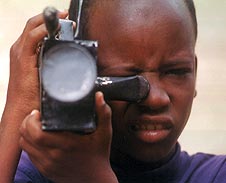
Within Bye, Bye Africa, there are hints that although Haroun is unable to square his own training and technique with the needs of his African audience, film is certainly not dead in Chad. Although the cinema halls are in a state of decay, the video clubs are bursting at the seams, and though people seem to express a nostalgia for the good old days of cinema, the stories they like are action films—not the worn out prints from the cinemas or the films about Freud that Haroun has made thus far. If we read Bye, Bye Africa as a tribute to his two mothers, the actual woman and the cinema, his final recognition of his persistent nephew who follows him about with his skillfully crafted toy camera is symbolic for his realization that though one loved one may die, there are others living now who must be appreciated. The camera that he gives to his nephew near the end of the film implies that the next generation will appropriate film technology to record that which is around them, their everyday life. And although he bids Chad, Africa, farewell, his nephew chases him down the street, filming him. In this conciliatory gesture, the new young filmmaker acknowledges that the expatriated Haroun, too, is now a part of the Chadian reality: he records him as he leaves, as if to say, you will not be so easily forgotten.

Saturday, May 26, 2007

Les Saignantes directed by Jean-Pierre Bekolo

In 1998, Nigeria’s brutal dictator General Sani Abacha died in bed with two prostitutes. The exact details of his death are not common knowledge, but the rumours abound. Some say his death “by heart attack” was Viagra induced; others spin tales of the prostitutes assassinating him with a poisoned apple. The myths that surround this historical incident point to the importance of the event in the national imagination, and have inspired oblique references in quite a few creative works.[1] In “The Last Sleep” a short story by Sunday Ayewanu, several mammy water spirits disguised as foreign prostitutes overcome the evil ruler of “Benueria.” In a sexual/spiritual struggle, they insist on him giving them government contracts and leave him dead with exhaustion.

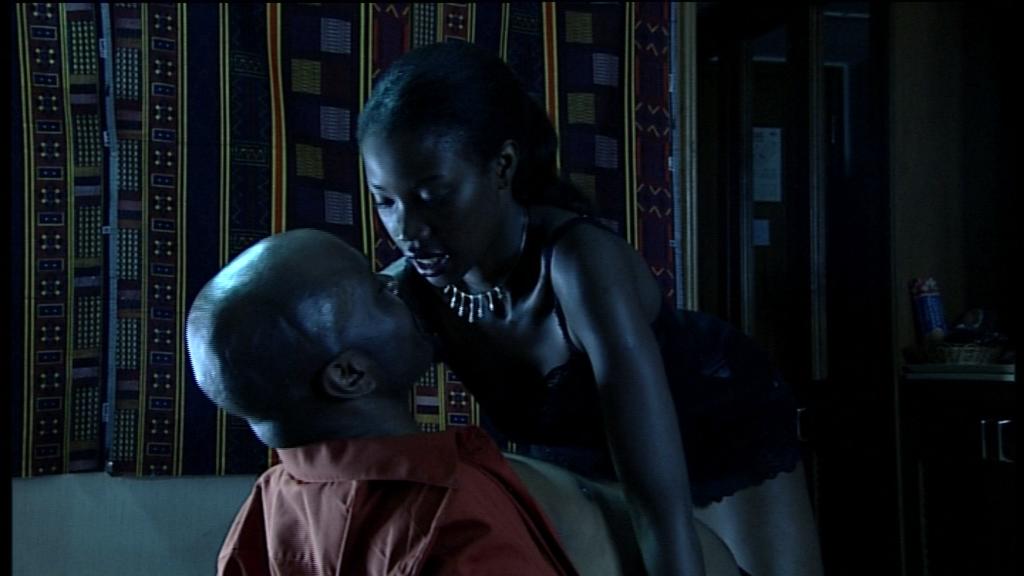
The sleaze surrounding the corrupt government of the Abacha regime and the almost spiritual nature of his fortuitous death, as imagined in Ayewanu, is what I thought of when I saw Cameroonian filmmaker Jean-Pierre Bekolo’s striking and disturbing film Les Saignantes, the winner of the 2007 Silver Stallion at FESPACO film festival. Set in the year 2025, the film opens provocatively with an almost naked young woman floating over a stout elderly man.[2] Strapped into a harness, she performs acrobatic sexual maneuvers— pointing her fingers in an imitation of shooting while thrusting her pelvis into his. Although the harness might seem to indicate the servile nature of the woman, here Majolie is in complete control. The old man lies back passively, waiting for her to swoop down upon him. The next thing we know the old man is dead. Whether this is an accident—he died of heart failure and old age—or whether this is a spiritual assassination performed in her shooting position, we are never quite sure, but it soon becomes apparent that Majolie has on her hands the death of a high ranking government official, the SGCC, who had been going to give her a government contract before he died in flagrante. The rest of the film traces the bizarre adventures she and her friend Chouchou go through to first dispose of the body, reconstruct it, and then hold an elaborate W.I.P (Wake of Important Person) to advance their own careers


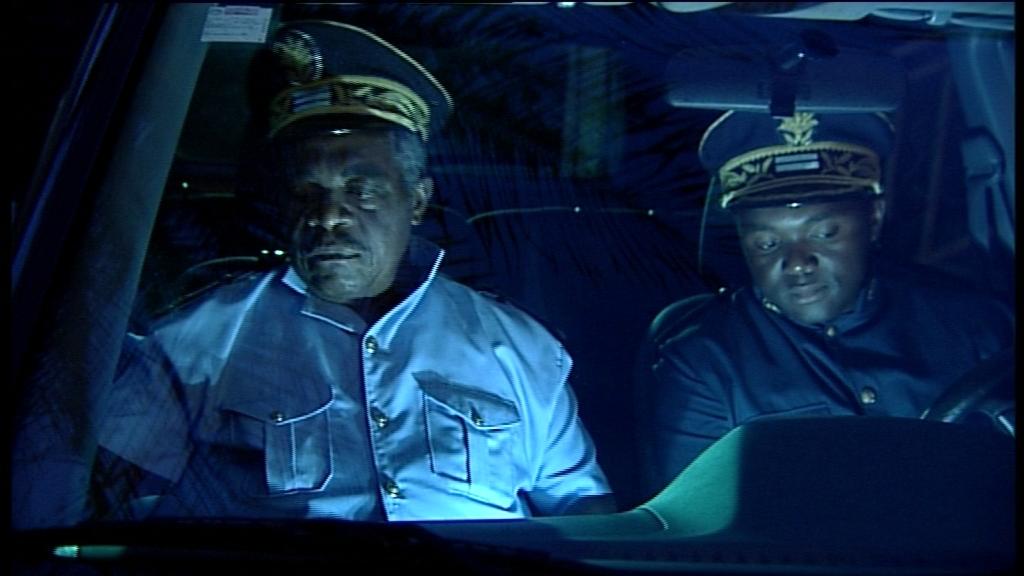
A futuristic film set in a dystopian Cameroonian city vaguely reminiscent of the dystopian Los Angeles in Ridley Scott’s classic BladeRunner, Les Saignantes is shot in high contrast lighting in what seems to be one long continuous night. The throbbing bass soundtrack of the film underscores the pulse of its rapid, jump-cut, music-video style editing. The characterization of the future city is a pessimistic allegory of the contemporary nation in Africa. By the year 2025, nothing has progressed; rather the country is still ruled by abusive power-drunk leaders who promise contracts to their mistresses; the police still take bribes and have no authority to actually investigate the crimes of the rich and powerful. Near the end of the film the smooth woman’s voiceover, which has performed the narrator’s function throughout the film, intones “We were already dead.” Re-watching the film with these words in mind, one wonders if the film, set a few years ahead in the future in 2025, is not the portrait of the spiritual aftermath of nation that has already died.

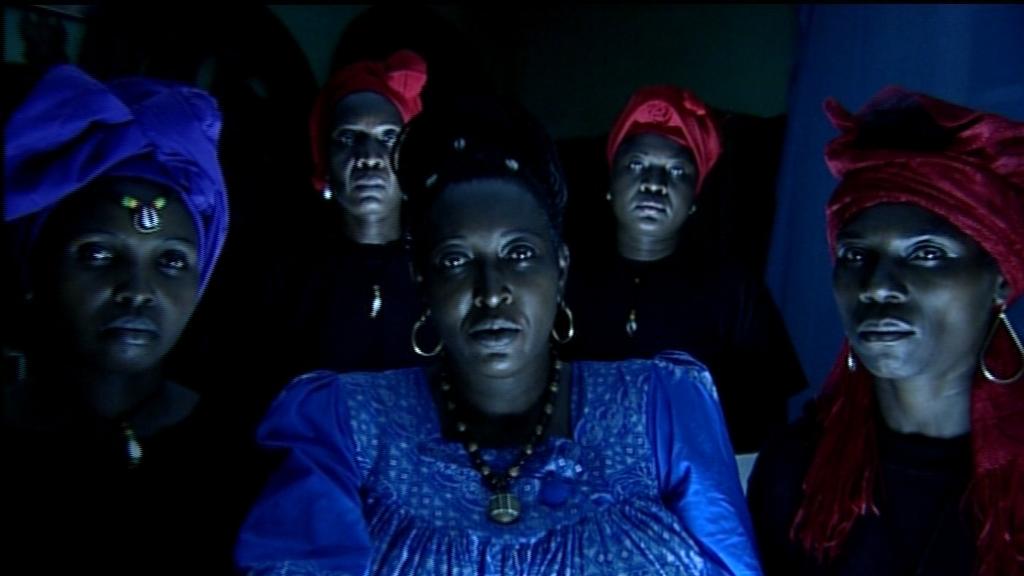
The entire culture seems to revolve around rituals of death. The W.I.P.’s become the ceremonies where political connections are made. At an elegant cocktail party or at home with Chouchou’s mother, the sophisticated revelers munch distractedly on maggots and drink what looks like radio-active embalming liquid from giant martini glasses. The mysterious women with their uniform of red headscarves, who cluster around Chouchou’s mother, flicker in and out like ghosts. The narrator makes it ambiguous whether any of the women in the film are spirits or ghosts, dead or alive. With the mysterious force mevoungou, referenced throughout the film, there seems to be little differentiation between the two.

Ghanaian philosopher Kwame Gyekye argues in Tradition and Modernity that “[t]he conception of modernity may give the impression that modernity represents a break with tradition and is thus irreconcilable with it; such an impression would clearly be false. For one thing, every society in the modern world has many traditional elements inherited and accepted from previous, that is ‘premodern’, generations…” (Gyekye 271). While Gyekye’s conception of modernity is optimistic, Bekolo seems to invoke death to illustrate the end results of a corrupted modernity. He visualizes the “mammy water” universe of “tradition,” in which the spiritual is inextricably tangled up in the tangible. Mevoungou the mystical power that controls the bodies of the young women after the death of the SGCC is a kind of lifeblood that lies at the heart of the society and which seems to provide the only hope for a “resurrection.”[3]


Given, Bekolo’s fascination with the process of filmmaking itself, I couldn’t help wondering if his portrayal of witchcraft and mevoungou does not have something to do with the medium of film.[4] The film opens, like so many other African films, with a voiceover reminiscent of an oral storyteller and is then interspersed with chapter captions: metaquestions about the possibility of filmmaking in postcolonial Cameroon: 1) How do you make an anticipation (futuristic/science fiction) film in a country with no future? 2) How can you make a film in a country where acting is subversive? 3) How can you make a horror film in a place where death is the party? 4) How can you film a love story, in a place where love is impossible? 5) How can you make a crime film where investigation is forbidden? 6) How can you watch a film like this and do nothing afterwards? After the opening chapter heading, almost half of the film passes before the second chapter comes, but the rest follow in a rapid succession, pounding home the point. If none of these tidy European genres (Science fiction, Horror, Romance, Crime/Investigation) can capture the paradoxes of postcolonial Cameroon, Bekolo indicates that he will create an uneasy amalgam of them all. His refusal to follow the “rules” of filmmaking, which has alarmed so many Western critics, indicates the subversive potential available to those who wield the camera.[5]

Les Saignantes references the grotesque humour of Quentin Tarantino and Hollywood horror films in the cliché of the chain-saw wielding cannibal, as well as the excesses of postmodern Hollywood cross-genre films (one of the pin-up posters in Chouchou’s bedroom is of Baz Luhrmann’s Moulin Rouge), but he also draws on African orality and urban-legend so often captured in Nollywood videos: government officials who use witchcraft to reinforce their corrupt power. Mevoungou used as a counter-witchcraft against the patriarchal order in Les Saignantes, works similarly to the sorceress’s sex-changing challenge to the patriarchy in Bekolo’s first film Quartier Mozart. Filmmaking, Bekolo implies, like mevoungou allows one to 1) expose the decay at the heart of power in the postcolonial nation and 2) to imaginatively overcome the powerful and corrupt leaders of the nation, using the subaltern figure of the young woman. As the girls prepare for the W.I.P., one of them expresses her fear that their plan will fail: “what if it doesn’t work? We’re just two holes that get screwed in the end.” However, if the postcolonial nation is often represented as a woman raped by the military, if in a crime-ridden urban environment, young women find that they are most often exploited for their sexuality, Majolie and Chouchou turn this symbol of the exploitation of women, their sexuality, into a weapon with which to destroy the powerful minister of state. Mevoungou becomes a potent source of agency and of imagination. As the camera lingers on dark city streets, the final few sentences of the woman’s voiceover clinch the parallel between the witchcraft and filmmaking: “It was mevoungou dancing, dreaming. Mevoungou danced, dreamed in technicolour. We were living in 2025, children behaving as if we had no parents, no children. We had to move on. The country could not continue like that. We had to change”


Read through the metaquestions that structure the nonlinear narrative, Bekolo’s film can be interpreted as a call to action. As the gigantic moon sinks behind trees, the final chapter caption emerges: “How can you watch a film like this and do nothing afterwards?” The tangled plot recedes leaving his questions in relief. This is not merely a pessimistic vision of the future but an indication of imaginative possibilities opened up through the medium of film.


NOTES
For a trailer of the film see this you tube clip:


[1]Nigerian novelists Chimamanda Ngozi Adichie in Purple Hibiscus and Helon Habila in Waiting for an Angel both subtly reimagine what Christopher Okonkwo calls the “woman-implicated death” of Sani Abacha. Okonkwo notes that Beatrice’s poisoning of the abusive and authoritarian Eugene in Purple Hibiscus re-enacts Abacha’s death. I argue in my MA thesis on Waiting for an Angel that the mob of women who break down the billboard with a smug condom-wielding man foreshadows Abacha’s death that occurs on the margins of the narrative.
[2] The costume that Majolie wears in this scene is visually reminiscent of the famous metal bikini Princess Leia wears in George Lucas’s classic science fiction film Return of the Jedi. The intertextual link here is significant in that Princess Leia is also involved in a struggle against corrupt male-dominated government structures.
[3] Chouchou’s mother and the women in her house who appear and reappear on beat visually echo the witches in Bekolo’s earlier film Quartier Mozart. In Quartier Mozart the neighborhood witch and a young girl named Queen of the Hood change sexes to infiltrate the world of men and expose hidden corruptions at the heart of the patriarchy/nation, represented by the policeman MadDog.
[4] My word choice here is intentional. The definition of the medium as a person through which a spirit is channeled and the medium as the material out of which art is created seem to be conflated in Les Saignantes.
[5] In a quick survey of film reviews on blogs, most of the ones I found were overwhelmingly negative--much of the criticism centred around Bekolo’s assumed inability to follow the rules of filmmaking: http://www.twitchfilm.net/archives/003429.html, http://www.fardelsbear.com/fn3/archives/cat_les_saignantes.html, http://www.blogto.com/toronto_film_festival_2005/2005/09/les_saignantes_at_tiff/


Works Cited:


Adichie, Chimamanda Ngozi. Purple Hibiscus. Chapel Hill: Algonquin Books, 2003

Ayawanu, Sunday. “The Last Sleep.” Cramped Rooms and Open Spaces: An Anthology of New Short Fiction from the Association of Nigerian Authors. Ed. Ibrahim Sheme. Lagos: Nayee Press, 1999. 16-28.

Bekolo, Jeanne-Pierre, dir. Les Saignantes. Quartier Mozart Films, 2005.

_____________________. Quartier Mozart. 1992.

Gyekye, Kwame. Tradition and Modernity: Philosophical Reflections on the African Experience. New York: Oxford UP, 1997.

Habila, Helon. Waiting for an Angel. New York: Norton, 2003.

Lucas, George, dir. Star Wars: The Return of the Jedi. 1983.

Lurmann, Baz, dir. Moulin Rouge. 2001.

Okonkwo, Christopher N. “Talking and Te(x)stifying: Ndibe, Habila, and Adichie’s ‘Dialogic’ Narrativizations of Nigeria’s Post-War Nadir: 1984-1998” presented at ASA Conference 2005, Washington D.C. 17 November 2005.

Scott, Ridley, dir. Bladerunner. 1982.


Photo Credits: All from Bekolo Films.

Friday, May 4, 2007

La Vie Sur Terre (1998) directed by Abderrahmane Sissako


In Achille Mbembe’s essay, “At the Edge of the World: Boundaries, Territoriality, and Sovereignty in Africa,” he engages with Braudel’s notion of temporal pluralities—that there are multiple kinds of time: “temporalities of long and very long duration, slowly evolving and less slowly evolving situations, rapid and virtually instantaneous deviations, the quickest being the easiest to detect” and “the exceptional character of World Time” (22). In Braudel’s thinking, world time has control over certain spaces, while others completely escape it. Mbembe relativizes Braudel’s thesis by maintaining that 1) temporalities overlap and interact with each other. They are not completely segregated. 2) There is no place completely separate from “world history,” but there are modalities, or categories in which it is manipulated to fit with local variables (23).

Abderrahmane Sissako’s 1998 film Vie sur terre (Life on Earth) illustrates Mbembe’s idea of temporal modalities and plays with the idea of “world time.” In the village of Sokolo, everyone knows what is going on in the outside world. In the local radio station, ancient radios are interspersed with glossy images cut from foreign magazines: including an image of a happy Prince Charles, Princes Diana, and baby Prince William frozen in time years after Diana’s divorce and death. A young man enthuses over a Japanese SUV in a magazine, and tells the photographer about the doors in Abijan that open by themselves. The young men sit all day listening to RFE radio from France, on which the millennium celebrations in New York, Paris, and Tokyo are reported. The voice on the radio says: “Not all countries have the same time, but those that do are celebrating the millennium.” This statement seems to get at the heart of the film in which global knowledge from the outside permeates the village, but in which knowledge from the village cannot be found on a larger global scale or even in the next village. One suspects that in the nearby villages similar young men listen to RFE and know world news but do not know the news of the neighboring village.
This is illustrated in the multiple characters who try to make phone calls but cannot get through. The dusty sign “telephone a priority for everyone” is ironic. While on the “outside” everyone may have a telephone, this is obviously not the case here, where the telephone serves as the metaphor for the “inability to speak” to the outside world. The soldier cannot get through to his camp. Nana cannot get through to a nearby town. The character played by Sissako attempts to make a phone call to Paris, but it is misdirected to London. The characters wait for people to call them back—since the telephone seems to work like the news, only in one direction. When the person from Paris gets through the disabled postmaster leaves the phone off the hook and sets off on his crutches to find Sissako. He disappears into the village, and nothing more is heard of him or of the call. Information seems to be lost in a time warp.
The gap in communication and time is contradicted by the visual movement of the film. Far from being a place where “nothing happens.” Sokolo is characterized by constant bi-directional movement. If communication moves soley from the outside to the inside, the daily activities of the villagers movement of the village crisscross. Throughout the film, if a bicycle or other vehicle passes from the right to the left of the frame, a canoe or a donkey cart, or another bicycle will cross from the left to the right. The visual back and forth of the film performs multiple times on a small scale, what Sissako does on a large scale with the form of the film. The initial opening in the French supermarket fades into the large tree (representative perhaps of history?), and then the old man reading the letter from Sissako in Paris. If the film opens with communication pointed toward Sekolo, The rest of the film is an outward response to this initial letter from the outside. The man dictating the letter to his brother in Paris does on a small scale what the entire form is doing: taking the news of Sokolo to the outside.
At the very end of the film, Nana, with a determined set to her face, pedals off on her bike, apparently to the neighboring town she has been trying to call. If she cannot get through on the phone, she will go there in person. This resolve to take herself there is what Sissako has done with the film: he has brought the village, like a letter, into the global discussions of the millennium, where its existence in time can no longer be ignored.

Work cited in addition to the film:
Mbembe, Achille. trans, Steven Rendall. “At the Edge of the World: Boundaries, Territoriality, and Sovereignty in Africa” in Globalization. Ed. Arjun Appadurai. Durham, NC: Duke University Press, 2001.
For more information, see also this interview with Sissako.

Lumumba (2000) directed by Raoul Peck


The following is on the film Lumumba, a historical film based on the events surrounding Congolese independence and the murder of the first Congolese prime minister Patrice Lumumba. The film is directed by Raoul Peck, who ten years earlier directed a documentary on Lumumba's life, Lumumba: Death of a Prophet.
(I've reposted this review from my other blog.)

Near the beginning of Raoul Peck’s film Lumumba, as Patrice Lumumba and his political comrades passionately discuss decolonization, the hot-headed Maurice Mpolo exclaims in frustration, “We’ll eat them raw!” “Be careful,” Lumumba replies with an ironic smile, “They’ll take you for an anthropophage.” The idea of cannibalism that Lumumba invokes here is a joke, yet it also provides a potent historical metaphor that is subtly reflected in images throughout the film. These images of “cannibalism” allude to the larger cycle of violence and suppression that is shown as thematic of Belgium’s historical relationship with the Congo.

One of the stereotypes of Africa cultivated by the Europeans for centuries was that of cannibalism—the stock character of the missionary in the large black pot. In Joseph Conrad’s Heart of Darkness lauded as one of the “greats” of the Western canon, the narrator Marlowe calls the “natives” he sees, as he steams up the River Congo, “cannibals.” When Marlowe asks the “native” headman what they’d do if they caught one of him, the man says “Eat ‘im!”1 However, if the stereotype was used by racist Europeans to indicate the “savagery” of their colonized subjects, it was also deftly turned into a metaphor for the brutality and exploitation characterized by slavery, colonization, and subsequent European meddling in African affairs. The 18th century Igbo writer Oluadah Equiano writes of his fears when taken aboard the slave ship and seeing the large copper furnaces he asks “if we were not to be eaten by those white men with horrible looks, red faces, and long hair?”2 In Ngugi wa Thiong’o’s novel Devil on the Cross, he imagines a grotesque competition of thieves and robbers in which fanged politicians propose creating a pipeline of blood from Kenya to the West. The violence against and exploitation of fellow human beings for economic gain both in the colonial era and the neocolonial era is the cannibalism that they project upon those they exploit.

In the film Lumumba, images evocative of cannibalism are shown in association with the supposedly departing Belgians. Framing the film are images of a celebration over which Mobutu presides; white women in queenly hats clink wine glasses and cut into a slab of meat. This opening celebration is interspersed with old photographs of Congolese enslavement under Leopold II and the Belgians. Resigned eyes in skeletal faces, naked chests. Chained hands. The image of cutting into meat is repeated when the two soldiers pull shrouded corpses out of a shallow grave, chopping into sheet covered flesh, sawing at it like tough meat. This hidden butchery symbolically provides the “meat” for the celebration. Although the celebration takes place several years after “independence,” the Belgians don’t seem to have gone anywhere. They continue to enjoy the “fruits of the land.” Moreover, by invoking Lumumba’s spirit, Mobutu cannibalizes his life and vision—using his death, which he had symbolically participated in, to provide the authorization for his own rule.

Mobutu merely continues in the structures (and cycle of violence) laid out for him by the Belgians. By refusing to allow Lumumba to do more than official “information gathering” until the official handover, the Belgians have effectively hamstrung Lumumba’s government. As the investors note during the meetings in Brussels, the entire civil service was Belgian—the Congolese had been deliberately been kept in inferior positions; with the departure of the Belgians, the system for the operation of the nation collapses. The investors in Brussels seem to delight in these visions of chaos. Not only do they set the newly “independent” state up for failure, the Belgians and their allies continue to undermine the authority of the new government. The outside advisors are patronizing to the new prime minister and president to their face, and behind their backs they make deals that ensure the collapse of the nation—with the leaders of Katanga province, with Mobutu. When Lumumba’s plane is diverted and Lumumba orders the pilot to turn around, the pilot maintains that he is Belgian and defies the prime minister, obeying the orders of his Belgian superiors to land. When Lumumba is being smuggled out of his house, the soldier who inspects the car mentions that he is “smoking American cigarettes.”

General Janssens maintains that the army will always be under Belgian control and tells the soldiers that any indication otherwise were merely the lies of politicians. The discontent of the soldiers ripple out from this scene: the rape and killing of Belgians who had remained behind, the invasion of the government house, the massacres carried out under Mobutu’s leadership, and the final abduction and murder of Lumumba and his comrades. The Belgian soldiers who beat Lumumba in prison before independence are echoed in the soldiers who beat him on the plane and the leaders of Katanga who beat him in prison right before he is murdered. But behind this seeming “native” unrest are Belgian “puppeteers.”3 Janssens boasts seem calculated to rankle. The American CIA agent meets with Mobutu to assure him of American support. Belgians are present at the execution sight, and it is Belgian soldiers who saw into the bodies and dispose of them in fire. Just as the feast at the beginning was interspersed with photos of those who had been exploited by Belgium, Mobutu’s speech at the end of the film is interspersed with the images of the Belgian soldiers burning the bodies of the murdered leaders. In their prison cell before they are murdered, Lumumba and Mpolo laugh desperately together over Lumumba’s old joke about the “anthropophage.” They understand the futility of their own protest and the way in which they are being used—as Lumumba told someone over the phone before his arrest; they are “a sacrifice for the people of Congo.”

At the end of the film, Mobutu’s call for a moment of silence to remember Lumumba is metaphoric for the silence that was imposed upon the people of the Congo. However, the focus of the camera in the end upon the soldier indicates that though silenced, the truth is not forgotten. The soldier in the final shot resembles the soldier who took Lumumba into custody by the riverside. Lumumba had told him that he would regret participating in his arrest; and the soldier in the final scene stares at Mobutu with the knowledge of the truth in his eyes. The narrative device of Lumumba’s posthumous voiceover indicates that his voice cannot be silenced. Although the evidence is burned and Mobutu has “cannibalized” Lumumba’s memory to lend credence to his own rule, the people know the truth. And as the final voiceover indicates, “one day we will have a new history, not one written by Belgium, Paris, (etc), It will be our history.” The fire that the Belgians use to cover up the evidence of the murders can also be read as the fire of the communal imagination. The narrative device is self-reflexive. If there is to be a new history, then the telling of that new history has begun. The photos taken as trophies of Belgian occupation are used as accusations; the story of Lumumba’s murder is told; the “moment” of silence is over.
Footnotes:
1 Joseph Conrad. Heart of Darkness. Planet PDF p. 82 Downloaded 8 February 2007
2 Oluadah Equiano. Interesting Narrative. “Boarding a Slave-ship.” Downloaded 8 February 2007.
3 There are a series of repeated images that mirror pre-independence with post-independence. A recently beaten Lumumba looking out over the airfield as he descends the plane in Brussels for independence negotiations; and a recently beaten Lumumba looking out over the airfield as he descends the plane into captivity. The Belgian soldiers beat him in prison; then the Congolese soldiers beat him in the plane and in prison.
Image Credits: Zeitgeist Films

Monday, March 26, 2007

Le Déclin de l'empire américain directed by Denys Arcand (1986)

I could not admit this in the reaction paper I wrote for this film, but I walked out of the first half of the film (which our professor stopped early because he had to be at a meeting) reeling. Walking home, I kept being afraid that the people I passed would leap up to make some bizaare sexual confession. When I stopped off at the bank, I expected the teller to burst into a confidance of an orgy. The film leaves you in a bit of a fog, especially since it is set in a university. Seeing it, one starts to madly wonder if this sort of hedonism actually occurs regularly, and somehow one has just been blind and naive. Hopefully not. Set in a Montreal university community, gender roles are switched as the men stay at home to cook a gourmet meal, while the women work out at a local gym. The subject of conversation among both parties is unrelentingly about sex: promiscuous sex, S&M sex, wild orgy sex, interspersed by brief comments about the contents of the refrigerator or the well done-ness of the fish pie, which inevitably turn out to be sexual innuendos. The men are boastful: the history professor gleefully relates picking up “two American girls” one night and then taking the drugs they gave him when he sleeps with his wife the next; the women are ironic: Remy’s wife Louise tells of being stuck with a somewhat lethargic partner at an orgy that Remy persuaded her to go to, and Dominique tells of a under-endowed Italian policeman she once bedded. In both sets, there are innocents who are being educated in the hedonistic ways of their more sexually-experienced friends. The young male PhD student, who initially seems somewhat askance at the confessions of his professors, begins to test out his own dirty stories and ends up laying the recently published chair of the history department, Dominique. The somewhat naïve housewife, Louise, who knows her husband has affairs but has no idea the extent has a more upsetting night when Dominique reveals that not only has she slept with Louise’s husband Remy, but that Remy is the most sexually voracious and promiscuous man in the department. She seeks refuge in the arms of her gay friend Claude, a “cruiser” and art history professor who is worried about the blood in his urine. Claude holds her all night, and the ménage all join each other for breakfast again the next day. Fortunately for a squeamish viewer like me, most of the sex is talk; there are a few flashbacks to illustrate the sexual tales, but they aren’t as alarming as they could be—in fact most of them are rather funny, in a disturbing sort of way. The film is remniscent of Boccaccio’s Decameron—in which a whole party of men and women sit around eating, going on walks in the countryside, and telling bawdy stories.

And perhaps this Boccaccio connection is a good way to open my reaction paper since neither my queasy prudery or my summary of the film will be of interest to my professor. So, here is what I turned in:


The Decline of the American Empire directed by Denys Areand (1987)
The medieval Italian writer Boccaccio opens his collection of tales the Decameron with a reference to the black plague, “…in the illustrious city of Florence, the fairest of all the cities of Italy, there made its appearance that deadly pestilence, which, whether disseminated by the influence of the celestial bodies, or sent upon us mortals by God in His just wrath by way of retribution for our iniquities, … had spread into the West.”Boccaccio’s reference to the Black Plague invokes the end of an epoch—the death of an “iniquitous” society. Fleeing the plague a group of young people seek refuge in the country and spend ten days together eating, going on walks in the countryside, and telling bawdy stories. There are echoes of the Decameron in Denys Areand’s film The Decline of the American Empire, which opens with a long tracking shot that finally focuses on the chair of the history department Dominique being interviewed, by the graduate student Diane, on tape about her new book. Dominique’s interview sets up the philosophical underpinnings of the rest of the film; she speaks of a society in decline, later positing that Marx and Freud based their theories on guilt and jealousy over sex. When their grand theories don’t pan out then, people have nothing to base their lives on. In the face of doom, the reigning order seems to be to eat, have sex, and to, as Louise puts it, intellectualize their misery. The wild sexual tales the groups of men and women tell are devices to combat a “suburban” boredom—the meaninglessness of growing into old age, of pursuing an academic career when there are “17,000 scholarly articles published a day.” The household of bawdy storytellers in the Decameron is reflected in the household of intellectuals who seem to belong to a type of commune, living in neighboring houses and eating meals together. The apocalypse, which has already struck in the Decameron, has not yet occurred in The Decline of the American Empire, but it hangs over the Montreal party like a dark cloud. In the first half of the film as the characters carelessly relate tales of casual group sex and S&M, there is an impending sense of doom. The gay character Claude laughs along with the other men about the STD’s their wives and lovers complain about (“Disease is a part of sex”), but privately agonizes in fear over the blood in his urine. When Claude tells of how he is often robbed while “cruising,” and a little later Dominique tells how she has also been robbed in foreign countries after sex with strangers, I felt uneasily that these intellectuals are living dangerously—that something is bound to go terribly wrong. But then, they know they are living dangerously—the uncertainty is part of what gives them pleasure. Diane, who is experimenting with sado-masochism with her brutish boyfriend, says of their connection, “We could kill each other.” When the sinister boyfriend shows up outside the house and eavesdrops on the men’s dirty stories, it seems as though the “real” thing has showed up and caught them at their game. He embodies the sense of foreboding I felt through the first half of the film. The characters seem so caught up in their dangerous pursuit of pleasure that they have lost any connection to each other. The women sneer at men’s small penises and their obsession over them. The men scoff at women’s desire for romance before sex. Remy delights in “knowing the dinner is on and stopping off on the way” or in “not mixing his sex life with his marriage.” The characters seem to constantly act out of disdain for each other.

However, Dominique’s revelation to the group of friends that she has slept with Remy and Pierre is somewhat of an anti-climatic moment---apocolypse has not happened—she’s just burst what she calls Louise’s self-delusional attempt to find happiness. The reappearance of the sinister boyfriend, ends not in a murder but in a cutting through all the pretence: “They were talking about sex all day. I was expecting an orgy, but now the big deal is a fish pie. When I want sex, I fuck.” His declaration opens up the way for more confessions. Although in the segregated bravado found in the reversed role chatter (the men at home cooking while the women work out at the gym), the men and women seem to joy in putting down their spouses or lovers, glorying in the details of abstract sex, when the party comes back together, we see that there actually are strong emotional connections between them. Suddenly, the sexual talk becomes intellectualized and sentimental confessions are made. Pierre confesses that these friends are his family. Dominique confesses that she has slept with Louise’s husband. Alone with the young PhD student Alain, Dominique confesses that she resents women with “cute little husband and cute little children, who don’t live in reality.” Pierre, who has spent all day boasting about his sexual exploits and his emotional disconnect from his lovers, confesses to his young companion Danielle that he loves her but that he is too tired for sex. The suddenly disillusioned Louise weeps herself to sleep in Claude’s arms, and Claude confesses to Diane that he is worried about the blood in his urine. Even Diane’s rough lover unexpectedly pulls out an absurd gift wrapped in heart-covered wrapping paper, attached to a bobbing heart-shaped balloon. The tough exterior bravado conceals a vulnerable desire for intimacy. The bluster of the day before fades away to reveal connections so deep that even after feeling betrayed, Louise finds herself unable to leave the house, instead joining Danielle to play a stormy piano duet. It was at this moment, that I realized what the piano music bursts at intervals throughout the film reminded me of. It reminded me of Jane Austen films—of those repressed stories of society and manners and the search for love—the house parties of young people who fight boredom by playing piano duets and proposing, as in Mansfield Park, bawdy plays to wile away the time. Perhaps the boredom that the characters express isn’t so new but is, in fact, built into the structure of the American/ European empire.

Edward Said has noted that the genteel life Jane Austen describes in Mansfield Park would have been impossible without the slave plantations that Fanny’s uncle owned and the profits made from a budding British empire.[2] Patricia Rozema has further explored Austen’s references to the Caribbean in her film adaptation of the novel, delving into the wounded psyche of the eldest son Tom who has witnessed and sketched slaves being raped on his father’s plantation. Throughout The Decline of the American Empire are similar sexualized references to the “other”—which conceal objectifications of different races similar to that statement Fanny’s uncle makes in Rozema’s film that “mulatto women are like mules. They cannot reproduce.” Remy opens the film with leering references to a Vietnamese girl in his class. He catalogues the distinct pleasures and scents experienced when sleeping with women of various ethnicities. When the young Alain good-naturedly accuses him of being racist, Remy laughs that “there is no better friend to the Negro,” relating a time when he took a distinguished visiting professor from Burkina Faso on the hunt for prostitutes and tried to haggle the price down by claiming it would be “aid to Africa.” On the women’s side, Dominique smirks at what she sees as the social climbing of the two Martiniquean men she paid to sleep with her, and Diane maintains that she likes the “African blacks” better. These distinguished professors speak knowledgably about oppression and racism in South Africa; yet their academic concerns seem merely a sham (as Dominique theorizes on Marx and Freud) to cover their ravenous sexuality. That their racist sentiments slip out along with their tales of sexual escapades indicates that perhaps their identities are as much caught up in the ideologies of superiority, as Jane Austen’s characters. Since these characters are Quebecois who are themselves postcolonial figures, in the struggle against being incorporated into an “American empire,” their “colonial” language is doubly ironic. Even more than the unihibited sex talk, this need to define oneself against the “other” marks the fundamental weakness in their society.

[2] Edward Said. Culture and Imperialism. New York: Vintage, 1993