Tuesday, August 5, 2008

Jiji, a novel by Changchit Wuyep: a summary and conversation with author

With a storytelling flair remniscient of Amos Tutuola, Abubakar Imam, Flora Nwapa, and Zainab Alkali, nurse and writer Changchit Wuyep spins a tale about a Sinbad-like hero, Jiji, that is rooted in the worldview of the Tarok people of Plateau State:

In one of the worst storms ever seen in the village of Jangnap, a child is born who will bring both misfortune and deliverance his people. Claimed by a river goddess who will not be appeased, the child is miraculously saved from drowning by a gorilla and is raised by mountain people, propelled from one adventure to another by multiple warring gods, who desire him as their champion. The novel takes the form of a journey in which the hero and his faithful gorilla companion are pulled between two forces of dark and light, the water goddess and the mountain god. While given supernatural forces by the gods, his strong sense of justice comes from what he has learned in his years of travel in the mountains, the forest, the desert, and the sea, and his interaction with hermits and villagers, spirits and gods. After having grown from an infant to a man, Jiji arrives back to Jangnap. It is his sense of justice learned of his wanderings, even more than the gifts of the god, that bolsters him in his final battle against oppression.


Conversation 2 August 2008 with Changchit Wuyep, the author of Jiji

Changchit Wuyep is an author and a midwife working with the Plateau State Hospital Management Board.

T-C: Could you tell me a little bit about how you came to write the book.

CW: Well, I used to be so much interested in stories when we were children. Our mother used to entertain us a lot with folklore. As I grew up, I became interested, wanting to know more about the culture of our people. That is why I decided to go around to some major tribes in Plateau State to get to know more about their culture, especially that of the Tarok people.

T-C: So, in this book you tell the story of a child who was lost and who was raised in part by a gorilla and in part by people who found him, and goes on this long journey. How much of this are stories that you’d heard before and how much is something that you made up?

CW: Actually, the entire story is made up. You know, I used to be an avid reader of stories, so one day I just decided that why don’t I, too, write something that somebody will buy and then read? That I will have pride if I see somebody reading my own work. That was why I sat down and constructed the whole thing.

T-C: So it’s a story that you made up entirely?

CW: I made up the whole thing.

T-C: You mentioned that you enjoyed reading a lot of books. What would you say are books that are your influences, or books that you have enjoyed reading?

CW: The Land of A Thousand and One Nights.

T-C: Ok, I saw reflections of that!

CW: And then, I did read some Shakespeare too. I have read the Complete Works of Shakespeare, but most especially The Land of A Thousand and One Nights. That is the one that had a great impact on me.

T-C: What about Hausa novels. Have you read, like, Abubakar Imam?

CW: Yes, I read the story, of, somebody the Blind Storyteller, is it Malam Shehu the Blind Storyteller? I can’t remember the author of that book. You know, we read that one so long ago in primary school, over 30 years ago.

T-C: Did you read Ruwan Bagaja or Magana Jari Ce by Abubakar Imam?

CW: I have not come across those novels. You know I have problems understanding Hausa grammar. That is why I have not read many of their books.

T-C: What about films. Have there been any films that have influenced you?

CW: No, most of my working life has been in the rural area. So I hardly watch films, so to say.

T-C: Did you ever read the Jungle Book by Rudyard Kipling?

CW: Jungle Book? No.

T-C: No? That’s interesting. The novel reminded me a little bit of that because that’s another one about a child that is abandoned in the forest and is raised by animals and grows up…. So you mentioned that a lot of information came from your brother. Could you tell me a little bit about the cultures that are represented in the book?

CW: Like icir? That icir is more or less the kind of magical thing. It is demonic in origin, because although I never went near, there was an instance that it happened in our village. Somebody was pounded to a pulp in a mortor. And you know, after pounding, this same human being, they would make some incantations and surprisingly the man would just get up. But like you saw recorded in that book, if there happens to be an enemy around and he is more powerful, he will make their powers fail until they go and beg him. And even then, he has to agree before that person so pounded will come back to life. So, there are a lot of demonic influences there. But the icir is a wooden effigy, a short wooden effigy. I saw it once.

T-C: So, in the book, Jiji is Tarok?

CW: Jiji is Tarok.

T-C: What are the other cultures he encounters in his journey around?

CW: Well, like I said, the Tarok Culture, which he came to I think at the tail end or so. He started with the Ankwai culture. The Ankwai are our nearest neighbors south. And as you can say they have this Nienman as their major goddess that they worship…. You saw something recorded about this anthill. That is the dwelling place of their god. Normally they have different ways of worship that we’ve seen recorded there. A masquerade will interview women. Women have to come confess everything they have done in life. Interestingly, the men do not confess anything. It is only the women that will line up, and even then they will have half a chicken in their hand, and they will begin to confess everything they have done. I am trying to remember the name of that anthill. It has a name: Matkarem. That is their goddess that they worship.

T-C: And is Patmala [the river goddess who plays a large role in the novel] an actual goddess?

CW: Patmala is somebody that exists only in my imagination, and nowhere else (laughs)

T-C: It seems to fit in with other stories of mammy water spirits and that sort of things. What about the mountain god?

CW: Gungun? Gungun was made up by myself. I just made him up.

T-C: That’s very interesting because there seemed to be a struggle between him and Patmala.

CW:Between him and Patmala. Yes. There are over three of them. Like Nienman. Patmala and Gungun. They were all interested in him, but the two major characters in his life are Patmala and Gungun…. You know there is one interesting thing about the culture of our people here. I don’t know if you noticed that. Because if any food is being prepared for a god or goddess, they normally have a particular grindstone, and there is a law guiding the rule of that grindstone. It is not anything that you grind on it—you only grind what will be used for that occasion. And once it is over, it is kept aside, waiting for the next occasion when it will be used. So that is peculiar to most of our people on the southern plateau.

T-C: So, the Tarok people, where exactly on the Plateau do they live?

CW: We are on the lower Plateau. And interestingly Tarok—Langtang is the only local government that has a single tribe. Like in Jos here you have the Burim, the Miango, the Naraguta. But in both Langtang north and south, it is only Tarok people. And they are non-warriors. Ask anybody around. Although… they say we are too proud, we are too this, we are too that.

T-C: So in the stories that you heard growing up, were there elements of this at well? Were there any specific parts of those stories that you put in the novel?


CW: No, in fact I just sat down one day and imagined all this thing.

T-C: How long did it take you to write?

CW: It took me over a year. The reason is that as I was writing, it came to the point where Poyi, one of the characters that shaped Jiji’s life, you know, it came to the point where they had to separate. He had to die. And I couldn’t find it in my heart to write that, even though it is fiction. So it took me months before I made up my mind and wrote it. Then later on, I felt that the whole thing was not worth anybody’s time. So I just kept the book aside, until my daughter disturbed me so much that I had to pick it up and complete the story.

T-C: So that was in…?

CW: I wrote this since 1990. I wrote this in 1990 and put it aside….The reason I left it for so long—you see that is why piracy is a very wicked thing—there was this Swedish man who said he was interested in it. So, at the time that he came, I gave this script to somebody to edit for me. Each time the man would come to Nigeria, I would go to him to give me and he would say, no, he has not finished working on it. He came the second time, the same thing. So, the third time when the man sent for me, I went and said, ok, you say you are not finished, just give me the script the way it was. He said, no, his secretary had taken it somewhere, and he couldn’t get it. It was not until the [Swedish] man was banned from Nigeria, because he went and produced The Man Died with Wole Soyinka—so it was when he was banned from entering Nigeria—that was when the man came and gave me the script. Not knowing that he himself is interested in it. He asked me to come that we should make a film with it, but I refused. Originally, we made it as a film script. It was the late Mandazi [sp?] who advised me to publish it as a book.

T-C: Would you be interested in having it made as a film now?

CW: Yes, in fact, originally, I wrote it as a film script.

T-C: Do you still have the original script that you wrote?

CW: My house got burnt, nearly got burnt one time. So the whole original script was burnt. If not because this one was with that man, the whole thing would have been burnt.

T-C: So, at least that helped!

CW: Well, it turned out to be a blessing in the end.

T-C: Wow, sorry. Yes, I was thinking as I read this. This would make a nice film, or an animated film, or--

CW: I just took it to this--I don’t know if you know the late Mandazi [sp?], the one that used to produce Behind the Clouds, the soap opera. He is the one that said, no, that I should make it a book, if not, people would pirate it, and I would be left high and dry.

T-C: So maybe if you do the book first and then someone does a film from the book?

CW: Yes, that is what he said. So, if only I can be connected to any of the Film Corporation. Reputable ones, I would be very happy.

T-C: Well, you know if it is published, maybe someone will want to make a film from it, even a children’s film. Even though it’s not a children’s book, I think it could make a film that would be appropriate for children to watch…

CW: You are the tenth person or more that has been telling me this. You know most of the people who read it say “make it into a film, now!” And about five people approached me one day, just in one day, and said that I should write a part two of this thing. That this one is not complete according to them. So I am already on chapter six—Jiji part two. So, this one will be printed as Jiji part one.

T-C: So part two, is that about his marriage and his life after?

CW: Yes, his marriage, and the exodus. You remember I mentioned one island there. So, it will terminate when the whole people settle on the island.

T-C: The other thing I wanted to ask you about. The songs in the book. Did you write the songs or were those Tarok songs?

CW: I wrote the songs. You can see that it is a challenge. I explained that the song is praising Jiji and teasing the dwarf, Nwaka.

T-C: Have you ever written in Tarok or Hausa, or just in English?

CW: Just in English. Actually I am working on [another] one. This one I aim at helping youths to come out of drug addiction, all these things by exposing the ills, I use characters to expose ills.

T-C: Is it a more contemporary story?

CW: Yes.

T-C: So, you have the new project. You have part two of this. Do you have any other works in progress?

CW: I have others in the offing. It’s just to find the time to sit down and finish them. Most of my energy is geared towards finishing the one I am telling you about. Because I hate the way you find children being involved in drugs and so on. So we are working on it with consultants at JUTH, Dr. Audu.

T-C: So what is a brief summary of the story?

CW: I just used characters to depict the various type of drugs, their complications, you understand? The effect on the youth. I used even alcohol, so that the children, as they read, they will see that from drugs, they don’t only end with drugs alone. They either become armed robbers, ritual killers, or even occultic members. They are initiated into most of these things as a result of taking drugs. So, I’ve used different drugs to depict their own peculiar complication. For example, you know this solution that they take, it results in blindness sometimes. Or the Indian hemp, sometimes they go mad, or they even die as a result. I have done some research into various means of how the youth are now taking drugs. You may be with them, but you won’t know-- I can be transacting business with the person around me and not even know that I have just been transacting business. So those are some of the things that I depicted in that write-up, although I have not finished working on it.

T-C: Do you have any other write-ups that you are in the process of working on?

CW: That one and Jiji Part Two, and there is another one, Safiya. In that one I aim to depict the ill effect of unforgiveness. It is going to be good. I know I am the one writing it, but I know it will be good. (laughs) I am on chapter seven, but I will stop that one. I want to finish the others. I have finished my life story. It is called Silent Tears Turned Amazing Grace. I am just waiting for some events to unfold, then I will just complete the book. And I have about twenty songs written down. I am looking for children with whom we can rehearse these things. But money is a problem…. I brought a copy of a song last time [to Jos ANA] to show the people there. That one is very close to my heart. You know I am a children’s evangelist, so I like to do things that will help them. Maybe one day, I will bring some of them for you to see. I have written the “Widow’s Song”, “An Orphan’s Song,” then the “Children’s Plea,” and “Wakar Nijeriya,”—this one is in Hausa. And many others songs about social vices.

T-C: Do you write a lot of songs in Hausa?

CW: Most of them are in Hausa, about social vices. But I need someone to help me, and being in rural areas is a problem.

T-C: When I was reading Jiji, I felt that the rural area really came out. There was a nice sense of the landscape in the book…. So, you’ve talked about things that you want to help people learn, are there lessons in Jiji that you want to bring out?

CW: Well, the lesson in Jiji is. I want people to know that evil is not good. For example, when you read about the Long Pell. And you see the end of it, and some of the comments that Jiji made. He said that he is a friend of the poor but an enemy of the oppressor. That is the lesson of Jiji.

T-C: So, even though Jiji was set in precolonial times, do you feel that there were things that relate to contemporary life?

CW: Only the lesson that you learn from it. Otherwise, I don’t think there is anything that relates. But I also want people to know that in those days this is how the Tarok people are. For example, if you see the dressing of that man [in a photograph she wants to use as the cover for the next edition]. The children will now know that, eh, so this is how our people used to dress. Bows and arrows. Some of them have even forgotten about it. Icir. Most of them don’t know. Odem. Things like that. If you go to Tarok land now, you will hardly see idire. There is something mentioned there: idire. So this will now motivate them to ask what is edire, what is esu? That kind of thing.

T-C: So it kind of teaches them their history?

CW: Ehen

T-C: Well you did a very good job of that. It taught me something. Thank you very much.

Sunday, January 27, 2008

Review of Yeleen (1987) directed by Souleymane Cissé


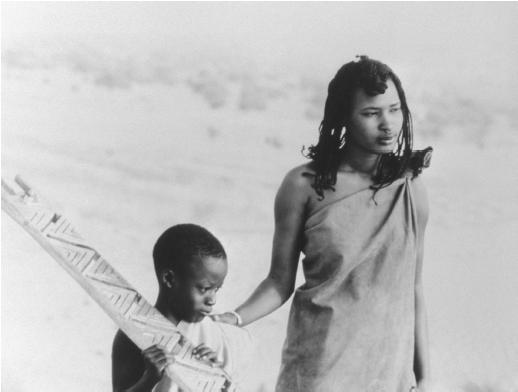
Yeelen (1987, Mali) directed by Souleymane Cissé

The visual patterning in Souleymane Cissé's film Yeelen reinforces the coming of age, journey motif and the parallel structure of the myth. Nianankoro’s mother sends him on a journey in which he travels from childhood to adulthood and must struggle against his father to find his own destiny. The struggle against the father counters the reformative new with the corrupted older tradition.


While Yeelen tells the story of Nianankoro’s journey from “childhood” to “adulthood,” from mother to wife, the pursuit and the chant of the father is a motif that stitches together Nianankoro’s journey. The father travels together with his two slaves and his post, seemingly driven by an anxiety that Nianankoro and his mother are trying to change tradition. And if tradition is defined as secretive purity, as Nianankoro’s (good) uncle implies when he explains that his twin blinded him when he asked him to “reveal secrets so that all might benefit,” then Nianankoro’s father has cause for worry. Although Nianankoro’s (bad) uncle disrespectfully dismisses the Peul king as a “little Peul” apparently because of their inability to do magic, the Bambara “nation” survives through Nianankoro’s marriage with the Peul woman. And at the end it is the Peul woman who is left to pass on the story of the “Bambara” nation to her son. Nianankoro penitently offers his life to the Peul king because he had “broken our laws” by sleeping with the king’s young barren wife; however, during the previous scene in which this sin is implied, the lovers seem lost in a trance comparable to that that the old men go through during their ritual. The smiling face of the girl appears to Nianankoro disembodied and surrounded by the same white light that blinds father and son in their final battle. The union of the Peul woman and the Bambara man seems to be fated, the breaking of the old law inevitable in order to bring about the new order. The Peul king seems to realize this, when Nianankoro’s uncle comes looking for him. Although Nianankoro and his new wife had left the Peul camp in shame, the Peul king refuses to betray him, saying that he had “helped us.”
The old laws have become corrupt. The father’s killing of the albino, the exploitation of his slaves, the blinding of his own twin brother, and the uncle’s arrogant dismissal of the Peuls contrasts with Nianankoro’s solitary journey and his ready willingness to help the Peuls who had initially taken him into captivity. After the mother tells Nianankoro how terrible his father is, we later find out that the father is pursuing Nianankoro because the mother has stolen his tools of sorcery. The mother’s theft counters the father’s cruelty. The importance of these two women (the mother and the wife) to Nianankoro also contrasts him with the father, whose world seems almost entirely made up of old men and young male slaves. Nianankoro seems to perform as the instrument of a more inclusive feminine world. The mother tells him his history and sends him on his quest. His wife picks up the story to pass on to their son. The “mothers” challenge the secretive authority of the “father,” while also revealing the chain of continuity in which the story is passed from mother to son.

Visually, the film takes us from the dark enclosed space of the mother’s house to the large empty savannah landscape that Nianankoro and his father travel across. Her prayer for Nianankoro’s safety, submerged as she is in watery purples and blues, parallels the end of his journey to the mountains and the long purple horizon as his uncle tells him of his origins. The framing of the purple horizon near the top of the shot is the same when the mother prays to the goddess of the waters “Save my son, keep him from ruin,” as it is when the uncle tells him “Last night, I saw a bright light cross the sky…. The catastrophe will spare your family.” The mother and the uncle are linked in their desire to preserve and share life; the father’s single minded purpose seems to destroy it. The uncle tells him that he became separated from his twin, when he asked him “to reveal secrets so that all might benefit. In a rage, he rushed out with the wing of Kore and blinded me.” It is significant, therefore, that the mother and the uncle are identified with water and greenery, while the father’s journey seems to be through the dry, brown landscape. The father’s practice is linked to death (the immolation of the chicken, the implied slaughter of the albino, the resolve to kill his son) while Nianankoro consistently preserves life: he ends the war between the Peul and their invaders, he plants the seed in the womb of the “barren” Peul woman. The flowing of the milk over the mother’s head is visually paralleled by the flowing of the waterfall over the son and his wife; it becomes a cleansing symbol of new life. It is not long after this ritual cleansing that the uncle tells Nianankoro that “if I were to die today and you too, our family would not perish. Your wife is pregnant with a son, who is destined to be a bright star.”

The catastrophe that the uncle predicts comes about. The father and son destroy each other in a battle of light, and leave behind them a landscape that seems completely devoid of life—the mother and son wander through dunes of sterile sand. However, rebirth is symbolized in the ostrich eggs that the boy uncovers in the sand. The mother and son leave the ostrich eggs in place of the wing, symbolizing the birth of a new tradition out of the curse of the old. Told history by his mother, Nianankoro’s son, “the bright star” will begin his own quest for light.

Review of Keita (1995) directed by Dani Kouyate


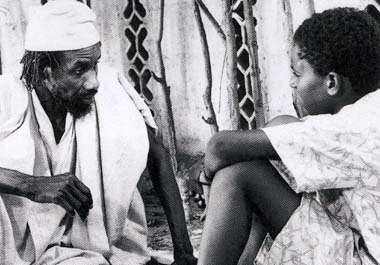
Keita (1995), Burkina Faso, directed by Dani Kouyate


As the griot Djeliba is leaving his young pupil Mabo’s home, he tells him, “Do you know why the hunter always beats the lion in the stories? If the lion told the stories, he’d win sometimes too.” This statement is at the heart of the conflict in the film between “tradition” and “modernity” and also hints at an aporia that opens the claim of any foundational story to deconstruction. The hunter and the lion of Djeliba’s proverb seem in the context of the two entwined stories to be as follows: hunter=the colonizer/neo-colonial ruler; lion= “traditional” ruler/his griot. (As D.T. Niane notes in an endnote to his transcription of Sundianta: an epic of old Mali, “the lion is the totem and ancestor of the Keitas” (85). Thus the lion in the proverb represents the history told by the griots of the Keitas).

The conflict manifests itself in the struggle between the “modern” teacher at the government school and the “traditional” teacher, the griot Djeliba. In school, Mabo learns that he “descended from gorillas,” that Christopher Columbus discovered America, and that the ancestors of the French, “the Gauls” were to be considered his ancestors as well. But, of course, Christopher Columbus did not discover America any more than Mabo’s ancestors were the Gauls. Because the Europeans conquered the Native Americans, their own history ceases to exist in colonial classrooms. Mabo’s history is similarly threatened by the story of the Gauls. It is significant that after Djeliba begins the story, Mabo is unable to answer his teacher’s question about the ancestors of the French—indicating that the history he has been learning from Djeliba is interfering with the hegemonic European version of history he is supposed to learn at school. Djeliba tells him that “your ancestors were not gorillas. They were kings.”

There is a tension between Djeliba’s notion of destiny and the teacher’s adherence to “the survival of the fittest.” The teacher maintains that if Mabo were to write that his ancestors were kings rather than gorillas he would fail the state exams; therefore it is beneficial not to question too closely what one is taught but “assimilate” to the expectations of those in power. Djeliba, on the other hand, encourages Mabo’s questions, and the story he tells emphasizes the coming to power of one who was most “unfit” because it was his destiny. In Darwinian theory, the ugliest woman in the kingdom who refuses the sexual advances of her husband for an entire year is the least likely mother of the king. A disabled boy who is unable to walk for years is the least likely king and founder of a dynasty. The idea of destiny, which in one reading could encourage an unthinking fatalism, here encourages a resistance against the story told by those in power—the grasping of power by those who initially seem most unlikely to succeed. The lesson Mabo learns, therefore, is that even those in power must bend to the dictates of destiny—that a previous history can undermine that taught by the conqueror. This is the significance of Djeliba ending the story of Sunjata as he and his mother and siblings go into exile. The powerful brother may have won this round, but as Sunjata claims, he will return. Similarly, although Djeliba chose to leave Mabo’s house after the open conflict with Mabo’s teacher and mother, this is not the end of the story. Now that Mabo knows the beginning of the Sunjata story, he will be sure to return over and over to this oral history to further understand his identity. Djeliba left the story near the beginning; Sunjata did return to regain control of the kingdom and become emporer of the Mali empire. Likewise, the film implies that the story of his history and his “destiny” will give Mabo and his friends, to whom he relates the story, the tools with which to overthrow the hegemonic knowledge of French education and create their own nation that acknowledges their own rich history.

However, the binary oppositions established between the ideas of “gorillas” and “kings,” between the “hunter” and the “lion,” are complicated by the existence of another aporetic space in the proverb Djeliba tells Mabo as he is leaving. If the lion is able to overthrow the hunter, the lion merely replaces the hunter’s hegemony. After all, the lion is a hunter as well. Perhaps the antelope that he hunts also has a story. In Djeliba’s story of the beginning of the world, he says that “Wagadou was the theatre of all creatures.” Mabo’s ancestor said “The world cannot go on without a leader. Do you agree?” With this, he offers himself as their leader, and the creatures “said together, ‘No one hates you.’ So he proclaimed himself king.” At the heart of this triumphant creation story, told as a way of legitimizing the kingship of the Keita clan, is a profoundly ambivalent moment. Mabo’s ancestor has proclaimed himself king, but while his proclamation was not challenged (at least in the telling of this story), neither was it enthusiastically welcomed. Although this ur-ancestor rises to the top in his story and the stories the griots tell about him, there are a whole host of creatures whose stories are subsumed in his, leaving the question: is it necessary to have a leader? Is it destiny that causes Sunjata to come out on top, or does the story maintain that it was his destiny because he did come out on top? What, ultimately, is the difference between destiny and survival-of-the-fittest?

The existence of the resistant women in the story, Mabo’s mother, the two stubborn buffalo women, and even the first wife of Sundiata’s father, reveals other voices that have been suppressed and twisted by one telling of history. Sundiata’s father “has to” rape his wife before the prophesied son can be born. Djeliba chuckles that women in the village who couldn’t do housework wouldn’t have been able to find husbands. As Djeliba tells the story, he and Mabo recline in the shade, while the servant girl washes dishes in the background. Djeliba’s story, while questioning the superiority of the new French colonizer, also reinforces stereotypes of the jealous co-wife, and the necessity of quelling a stubborn woman. Perhaps some of the resistance of Mabo’s feisty “modern” mother to his initiation comes from her resistance to the idea that her fate is ruled by her “destiny” as a woman. The housegirl remains at the bottom of the “food chain,” for even if Mabo’s mother claims “liberation” through the modern lifestyle of the urban Francophone environment, can this subaltern speak? And does the story she overhears, which is meant for part of a boy’s initiation, speak to her?


Works Cited:
Kouyate, Dani, dir. Keita: The Heritage of the Griot. Burkina Faso, 1995.
Niane, D.T. Sundiata: an epic of old Mali. Essex: Longman, 1986.

Review of Mahamat-Saleh Haroun's Bye, Bye Africa


Mahamat-Saleh Haroun. Bye, Bye Africa. 1999.

In his 1999 film Bye, Bye Africa, Mahamat-Saleh Haroun questions the role of African cinema in everyday African life. It appears that the models his semi-autobiographical protagonist, the expatriated filmmaker Haroun takes for making films (or those of the filmmaker he plays in the film) have more to do with French ideals than with what people in Chad actually want to see. When he returns home after years in France to mourn his mother, Haroun's father questions the use of his profession, noting that if he had studied medicine, he could have saved his mother. Referring to the film that Haroun made about “some European (Freud),” he asks “What’s the use of cinema,” claiming that “Your films are not made for us. They are made for Europeans.”


Haroun attempts to explain to his father the need to define himself in film: “The white man’s land is nice, but not yours. The day you think you belong you lose something.” His response indicates that his homecoming is a way of re-discovering his Chadian identity. After watching the footage of his deceased mother, he quotes Godard: “Cinema makes memory.” His decision to make a film in tribute to his mother indicates that he is retracing his steps—attempting to capture his memories of the events that have formed his life and his art. When he says “to forget my grief, I’ll make a tribute to the one who gave me life,” he simultaneously pays tribute to his literal mother and his symbolic mother, the dying cinema in Chad.

However, as is indicated in the opening scene that shows him answering a long distance phone call while in bed with a white woman, his ten years in Europe without traveling back home seem to have turned him into a European. He no longer seems to understand life in Chad. He walks around with the video camera, shooting everything he sees, as if he were a European tourist. When the man outside the theatre attacks him, he shouts “He is stealing our image,” and although Haroun thinks the man is mad, the situation is more complex than Haroun imagines. In his films oriented to a European audience, his images of Chad do become a kind of exploitation—stealing images of a crumbling infrastructures to offer the West as confirmation of Africa’s incapacity. The radio clip from Thomas Sankara’s speech about the imperialism of the West and the dependency that foreign aid creates reinforces Haroun’s ambiguous position. Even the title of his proposed film, Bye, Bye Africa, addresses Chad from a distance, homogenizing the individual experiences of a local place into the large abstract “Africa.” He is addressing Chad, at best, reflexively—over his shoulder.

Like a European tourist, Haroun does not recognize any responsibility he may have to the people whose images he captures in his films. When he asks the women trying out for a part in his film if they will agree to appear naked, he draws more from European/ American ideas of what cinema should show than from aesthetics born out of the cultures of Chad. When one of his former actresses tells him that her husband would object to her playing naked, he indicates that if she were a serious actress she would be willing to give up her husband for her career. Although she leaves with an ironic regret, another auditioning actress leaps straight to the heart of the problem: “Are you Chadian?” she shouts before storming out.

As his friend Garba indicates, in Haroun’s desire to make “real cinema,” he has forgotten the realities of life in Chad. Haroun seems little aware of how his film on AIDS affects the life of Isabelle: near the end of the film she tells him “Reality scares you. You hide in films. I am not a fictional character. I exist.” His careless use of Isabelle in the film overlaps with his careless use of her in real life. Indeed, over the course of the film he begins to learn what Isabelle warns him about, viz. that “Cinema is stronger than reality”—a lesson that is reinforced by the blurring of boundaries between a fiction film and a documentary. It is as if by acting an AIDS victim in his film, Isabelle has actually contacted a deadly disease that will kill her in the end. Indeed when they meet again after ten years, she foreshadows her own death “I’m finished Haroun. Your film killed me.” Her theft of his camera to film her final words, therefore, brackets her encounter with him: her troubles begin and end on film.
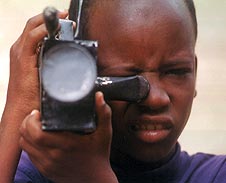
Within Bye, Bye Africa, there are hints that although Haroun is unable to square his own training and technique with the needs of his African audience, film is certainly not dead in Chad. Although the cinema halls are in a state of decay, the video clubs are bursting at the seams, and though people seem to express a nostalgia for the good old days of cinema, the stories they like are action films—not the worn out prints from the cinemas or the films about Freud that Haroun has made thus far. If we read Bye, Bye Africa as a tribute to his two mothers, the actual woman and the cinema, his final recognition of his persistent nephew who follows him about with his skillfully crafted toy camera is symbolic for his realization that though one loved one may die, there are others living now who must be appreciated. The camera that he gives to his nephew near the end of the film implies that the next generation will appropriate film technology to record that which is around them, their everyday life. And although he bids Chad, Africa, farewell, his nephew chases him down the street, filming him. In this conciliatory gesture, the new young filmmaker acknowledges that the expatriated Haroun, too, is now a part of the Chadian reality: he records him as he leaves, as if to say, you will not be so easily forgotten.

Review of Waiting for an Angel and Measuring Time by Helon Habila

First posted on my other blog and now on my "literary" blog.


If you’ve never read anything by the Caine and Commonwealth prize winning author Helon Habila, the first thing to know is that his use of language is exquisite. The second thing to know is that he makes generous use of irony. Although he is a clearly political writer, he questions over-easy assumptions and political binaries. In his latest novel, Measuring Time, Habila continues the project he began in his debut novel Waiting for an Angel—that is to tell history through the eyes of ordinary people.

Waiting for an Angel opens in a prison setting. The imprisoned journalist Lomba is engaged in a battle of wits with the prison superintendent who is extorting poetry from his prisoner in an attempt to impress a woman. If Lomba’s story were told in a straight line, the way it might appear in his prison file, it would be the story of a failure: a student who drops out of university, who loses friends to madness and military violence and the women he loves to other men, a writer who never finishes his novel and whose journalistic career is cut short by his arrest in the slums of Lagos. However, this is not the story that Habila tells. By breaking up and rearranging the linear story of Lomba’s life, he wrests control of the narrative away from an environment-determined fate. The novel starts at the end of the chronological sequence and then circles back to gather stories of other characters in Lomba’s Lagos: a young boy banished from his home in Jos for smoking Indian hemp, an abandoned out-of-wedlock mother, an intellectual in a tragic love affair with a former student turned prostitute, the daughter of a general whose mother is dying of cancer, a disillusioned woman who runs a neighborhood eatery, a man who defies the soldiers on the night of Abacha’s coup, an editor pursued by the police who refuses to go into exile, a legless tailor who dreams of bidding poverty goodbye.


While the form of Waiting for an Angel reflects the frenetic beat of life in Lagos, the small town setting of Habila’s second novel Measuring Time allows for a more meandering pace. Mamo and LaMamo are twins growing up in the middlebelt town of Keti, and they hate their father, a womanizing businessman with political ambitions. They hate him for breaking their mother’s heart before she died giving birth to them, and they hate him for his long absences and his neglect. The twins’ simultaneous desire for revenge and quest for fame ends in their separation. When LaMamo runs away in search of adventure as a mercenary soldier, Mamo’s sickle cell anemia forces him to stay at home, spending more and more time in his imagination. The narrative of Mamo’s day to day life in Keti is rhythmically punctuated by adventure-filled letters from LaMamo as he travels around West Africa. Mamo reimagines events in Nigerian history: the poet Christopher Okigbo did not die in Biafra but instead lay down his gun to travel around Africa with Mamo’s Uncle Haruna. LaMamo enacts Mamo’s imagined story, becoming a soldier-poet who reports from the Liberian war front, and his words capture the spiritual horror and the boredom of war as it is rarely recorded in international news. The twins long for the other: while Mamo imagines adventures beyond the borders of his small town, LaMamo constantly searches for reminders of home in foreign lands.


The narrative of Measuring Time is frequently interrupted by folktales told by Mamo’s Auntie Marina, letters from LaMamo and a professor in Uganda who becomes Mamo’s mentor, excerpts from the memoir of the first missionary in Keti, his wife’s diary, and colonial reports, and the oral histories told by other characters. One of the most remarkable aspects of Habila’s prose is this inclusion of multiple genres alongside a continuous pattern of tributes to preexisting literary works. In Waiting for an Angel, he borrows the character of the prison superintendent from Wole Soyinka’s The Man Died and gives him some of the associations of the folkloric dodo, a dim-witted monster who is often outwitted by the youth he kidnaps. Throughout the rest of Waiting for an Angel he references writers as varied as Ayi Kwei Armah, Ousmane Sembene, Ngugi wa Thiong’o, Franz Kafka, John Donne, and Sappho. Similarly in Measuring Time, he bundles together Plutarch, Christopher Okigbo, William Shakespeare, Wole Soyinka, Alex La Guma, the Arabian Nights and Faust legends, as well as references to oral tales and Nigerian video films. The effect of these competing voices is to open up the boundaries between his fiction and other fictions and historical accounts that lie outside the novel. The illusion of a smooth, progressive, and abbreviated history, such as the Brief History of West Africa that is brought to Lomba in prison (as the Letters of Queen Victoria had been brought to Soyinka in prison) is a false one. Habila’s fictional histories play a function similar to the colonial history the Pacification of the Primitive Tribes of the Lower Niger in Chinua Achebe’s Things Fall Apart in which the district commissioner writes only a paragraph on a man who has been the subject of Achebe’s entire novel. Habila parallels Achebe’s fictional colonial text in Measuring Time with the missionary text A Brief History of the People’s of Keti by Reverend Drinkwater.

It is with these “brief histories” that Habila’s project in both Waiting for an Angel and Measuring Time becomes clear. Mamo is determined to write a history that does not “cut details” as the colonial histories had—a history that tells the stories of “individuals, ordinary people who toil and dream and suffer” (MT 180). The traditional ruler’s story he has been hired to write, Mamo states, is “simply a part of the other biographies…. [that he would] eventually compile to form a biographical history of Keti. That’s what history really is, people and their lives, no matter how we try to manipulate it. It is the story of real people with real weaknesses and strengths and… not about some founding fathers and … even if we want to write about the founding fathers we shouldn’t privilege them, we should place them on par with other ordinary folks…” (225). In Mamo’s subsequent “biographical history,” he writes of his father the failed politician, and his aunt the divorced wife, placing their stories alongside the less than glorious history of the mai, the traditional ruler, of Keti. Every story has its own place alongside the others. When LaMamo returns with a revolutionary fervour reminiscent of Ngugi’s Matigari, the separate lives of the twins blend and become one—LaMamo’s panAfrican experience and his soon to be born child are given into Mamo’s safekeeping and for recording into Mamo’s history of Keti.


Such a history is not merely a radical rewrite of racist colonial histories but an empathetic window into the lives of even the unpleasant characters. The characterization of the prison superintendent in Waiting for an Angel follows Soyinka’s original caricature, but the man is given a more complex psychology. He is a man grieving for his dead wife, a father of a young son. As Lomba realizes when he meets the superintendent’s girlfriend, “The superintendent had a name, and a history, maybe even a soul” (WfA 37). While in Measuring Time, the sleepy-eyed traditional ruler of Keti and his evil vizier take on the typed characteristics of folktale or a video film, most of the characters in Measuring Time are treated with complexity and compassion. When LaMamo calls the old widows who had pursued their father all his life “shameless old women,” Mamo reminds him that “they weren’t so bad… People are just people” (MT 343). And although the missionary Reverend Drinkwater may have misrepresented the history of Keti, his family has become a part of the history of the town. The missionary’s daughters, now old women, live in Keti, tending their parents’ graves. Although they are not Nigerian, they belong in Keti. It is the only life they have ever known.


This concern with multiple perspectives on history is behind what at first glance might seem to be an editorial flaw in Habila’s two novels. When reconstructed in both novels, time doesn’t quite add up. According to the chronology given in “Mamo’s notes toward a biography of the Mai,” the number of years between the installation of the first mai by the British and the current mai should be about thirty two or three years, yet the time period is stretched from 1918 up to the 1980s (MT 238-240). The year-long planning period for the celebration of the mai’s tenth anniversary seems to turn into three. Similarly in Waiting for an Angel, the time between Lomba’s stay at the university and his imprisonment seem much longer than the actual historical tenure of Abacha’s regime. He supposedly meets and falls back in love with an old girlfriend some time after he becomes a journalist. Yet, two weeks before he is arrested (after he has worked at the Dial for two years), another girlfriend, with whom he has lived for a year, leaves him. The times between the two love affairs don’t quite seem to add up.

Placing the novels side by side gives a hint to what Habila is doing here. In Waiting for an Angel, Habila gathers up historical events that happened along a spectrum of ten years and bundles them into the space of a week. Although Nigeria is kicked out of the Commonwealth in November 1995, in the novel, a week after this event, Dele Giwa, the editor of Newswatch Magazine, is assassinated by a parcel bomb on the same day that Kudirat Abiola is assassinated by gunmen. Of course, historically, the two activists were killed ten years apart: Dele Giwa during the Babangida regime in October 1986 and Kudirat Abiola during the Abacha regime in June 1996. The quickening rhythm of disaster in this chapter of Waiting for an Angel parallels the last quarter of the Measuring Time in which Mamo falls into the hard-partying lifestyle of corrupt politicians, religious riots break out, and the quiet town of Keti goes up in flames. Time here is not a mathematical iambic pentameter that can be measured with a clock, but a living fluctuating force that lags behind and loops around to find the stories of multiple characters. It reminds me of the way time acts in Gabriel Garcia Marquez’s One Hundred Years of Solitude or in oral tales and epics. It cannot be diagramed into a dry progression of events such as those found in A Brief History of West Africa or A Brief History of the Peoples of Keti but instead can only be mediated through the memories of those who experienced it. In his afterward to Waiting for an Angel, Habila acknowledges the liberties he has taken with the chronological order of events, “[N]ot all of the above events are represented with strict regard to time and place—I did not feel obliged to do that; that would be mere historicity. My concern was for the story, that above everything else” (WfA 229).

Mamo’s story of Keti, like the story of Lomba in Waiting for an Angel, becomes in miniature the story of Nigeria—not that it can represent all the complex and multi-faceted stories of the nation, but that it offers an example of what can be written: the individual stories of ordinary people living in extraordinary times. Habila layers his work onto that of older writers such as Achebe and Ngugi who rewrote colonial history in their early works, and joins other contemporary Nigerian writers like Chimamanda Ngozi Adichie and Teju Cole whose writing seems similarly concerned with providing entry points into historical events as lived by ordinary people. Measuring Time ends with the performance of a play by church women’s group, both celebrating and mocking the appearance of the missionary Reverend Drinkwater into Keti history. Mamo realizes that through their caricatured performance, they are telling the story on their own terms, invoking a way of life much older than the colonial encounter: “They were celebrating because they had had the good sense to take whatever was good from another culture and add it to whatever was good in theirs: they had done this before when they first met the Komda, and many times before that in their travels and migrations, in times earlier than even the oldest among them could remember. This was their wisdom, the secret of their survival. This was why they were still able to laugh… each generation would bring to this play its own interpretation” (MT 382). This at root is the power of Habila’s work—the ability of humanity to laugh in the face of tragedy—the ability to undermine stories that have been told for you by telling them yourself.

Friday, August 24, 2007

The Book of Not by Tsitsi Dangarembga


I'm teaching Nervous Conditions by Zimbabwean author and filmmaker Tsitsi Dangarembga this semester, and while creating a study guide for it, I was reminded of the review I had done of the sequel, The Book of Not, on my other blog, originally posted 9 January 2007. It's buried in the archives and hard to find, so I thought I'd repost it on this "literary blog."

The Book of Not by Tsitsi Dangarembga

Here are my first impressions of The Book of Not by Tsitsi Dangarembga. I'd welcome a dialogue with anyone else who has read this book. (Warning: spoilers ahead)


"I was young then and able to banish things, but seeds do grow. Although I was not aware of it then, no longer could I accept Sacred Heart and what it represented as a sunrise on my horizon. Quietly, unobtrusively and extremely fitfully, something in my mind began to assert itself, to question things and refuse to be brainwashed, bringing me to this time when I can set down this story. It was a long and painful process for me, that process of expansion. It was a process whose events stretched over many years and would fill another volume, but the story I have told here, is my own story, the story of four women whom I loved, and our men, this story is how it all began."
--voice of Tambudzai, closing paragraph of Nervous Conditions by Tsitsi Dangarembga.

I’m trying to figure out whether my disappointment in The Book of Not is that of a literary critic or merely that of a reader who had loved Nervous Conditions and identified with the forceful yet ambiguous narrative of the main character Tambudzai. Perhaps it is unfair to impose my own expectations of a sequel so long awaited on the author, but from the promising tone of Nervous Conditions' last paragraph, this is the sequel I had imagined: Tambudzai continues at the Sacred Heart academy, does well, receives a scholarship to study in England, and discovers in exile the regretful, cynical voice with which she narrates both novels—finding too late that in her desire for advancement in the European world she had lost her connection to family, to history, and to herself. In the second novel, I imagined, she would begin to retrace her steps to find what she had lost. In any case, I expected that I'd still like the plucky yet imperfect narrator, whatever obstacles she may have to overcome.

This is not what happened. Instead the hints at selfishness and the craving for acceptance that we see in Nervous Conditions (her lack of grief over her brother’s death, her relief to get away from the homestead, etc) develop into a character who, by the end of her first person narrative in The Book of Not, is thoroughly un-likeable. Tambudzai dreams of greatness—greatness being that which will propel her ahead of her classmates, to a position where her family have no option but to be proud, a position in which she can have the vengeance of success to hold over her disapproving mother; she will demonstrate to her white classmates and teachers that she is capable of surpassing them. Although Tambudzai is clearly capable of achievement, her frustrating desire to please, her suppression of her rage, results in failure. Tambudzai’s interest in school has little to do with an actual interest in what she is studying but with honours, awards, and exam results. Nervous Conditions is a Dickensonian bildingsroman tracing the successes of the homestead girl who had the support of a benevolent uncle, an optimistic structure ironically undermined by psychological loss of self a la Black Skins, White Masks. In The Book of Not, Dangarembga systematically tears down Tambudzai’s accomplishments achieved in Nervous Conditions. The trajectory of the narrative is a steady descent into lower and lower levels of a self-negating hell.

Like Nervous Conditions, the story is told through Tambudzai’s unreliable first person narration, yet there are fewer moments of tenderness here. The author doesn't seem to like her narrator very much. Dangarembga takes a particularly bitter swipe at Tambudzai when she comes back to the mission on vacation and finds her subdued cousin Nyasha reading Ngugi’s A Grain of Wheat. Although Tambudzai has been attempting to memorize the complete works of Shakespeare for her exams, she displays an aggressive ignorance of African literature, saying, “[Nyasha] was reading a book she had not bothered to share with me, which rather than being revolutionary seemed to be about agriculture for it was called A Grain of Wheat, written as far as I could see by someone like poor Bongo in the Congo, a starving Kenyan author” (117). Not only is she ignorant of Ngugi’s work but she disdains the efforts of the other African girls to speak Shona together: “These seniors were planning to spend the entire evening trying futiley to turn back time by speaking Shona! Just imagine! Inviting a mark for refusing to accept which language was allowed and which was not when you were as far as the sixth form!... I was not going to identify with a group that spoke in the only language, out of all the ones that were known at the school, which was forbidden” (169). Success for her is in becoming what she is told to become, in rejecting that which is African to embrace that which is European. To speak Shona is to be out of date, to be insubordinate. Having had her early rebellion over using the white girl’s toilets beaten out of her, she no longer questions any rules placed upon her. This is the point where I miss the fiery character Nyasha, who plays only a peripheral and sedated role in this sequel, and whose blunt observations might have provided a balance to Tambudzai's desperate self-delusion.

The history of Zimbabwe here presented is bitterly cynical. The book opens with Tambudzai’s disjointed, almost incoherent, description of her freedom-fighting sister’s leg being blown off and her uncle Babamukuru being beaten by the villageres for being “not exactly a collaborator, but one whose soul hankered to be at one with the occupying Rhodesian forces” (6). This opening accounts for the terror the elite African students as well as the white students at Sacred Heart feel for the Zimbabwean freedom fighters. Tambudzai locks away her memories of her sister’s leg, until her classmate Ntombi comes to weep in her room about a baby cousin being drowned by “terrorists,” because “[t]hey said my aunt is feeding terrorists… Yes, she talked because of what they did to the baby. But it was too late. My little cousin was broken, just broken!... Then my aunt killed herself, because when it’s like that, you’ll never live… No one is alive!” (172). In an initial reading it is hard to tell whether the “Rhodesian” army or the “Zimbabwean” army has committed these atrocities. Tambudzai’s pain is so deep that she tries not to think about it at all.
Despite the struggle for freedom from white rule, the new Zimbabwe, which has emerged by the end of the narrative, mirrors the old. Language is cloaked in political correctness. At school, the girls are "consumed by ... terror" that they might inadvertantly break the school rules about physical seperation between the white and black students. If a black girl should accidentally touch a white girl in an assembly queue "looks of such horror flooded their faces at this accidental contact that you often looked around to see what horrendous monster caused the expression, before you realised it was your person" (58-9). This history is countered with hypocritical inter-racial hugs between the co-workers at the end of the story. But under this shallow familiarity lurks the old racist structures. Tracy, the white student, who knowingly stole Tambudzai’s trophy for the best 0-levels in secondary school, becomes Tambu’s boss. A white copywriter praises Tambudzai’s advertising copy for a hair straightening product and then takes the copy as his own, going on to win a company prize for the text. (The hair straightening product represents the continued structures of idealizing Europeans ideas of what is good, under new leadership. And Tambudzai’s ability to write sentimental copy about it demonstrates her imbrication in these mental structures.) Tambudzai’s dreams are crushed over and over again. She is the ultimate victim. Although she gets the best O-level results in the class, a white girl gets the prize, while Tambudzai goes unacknowledged. Upon becoming a senior, she chooses to focus on math and science, yet because of her race she is not allowed to attend the national boy’s school the other girls from Sacred Heart attend for the science classes. She is left trying to make sense of the sciences from the handwritten notes of a white classmate. Despite hours of study, she miserably fails her A-levels.

The reader sympathizes with her victimhood, until it becomes obvious that Tambudzai is unwilling to take any action to protest these inequities. She seems to almost aggressively seek a silent martyrdom in pursuit of her own interpretation of unhu, “that profound knowledge of being, quietly and not flamboyantly; the grasp of life and of how to preserve and accentuate life’s eternal interweavings that we southern Africans are famed for, what others now call ubuntu, demanded that I consoled myself, that I be well so that others could be well also” (103). Despite her resentment of racist rules which segregate bathrooms by race, she volunteers to knit socks for Rhodesian soldiers in the fight against her “elder siblings,” to comfort the children of a farmer killed by the “elder siblings,” to ensure that she is viewed favourably by the administration. When Tracy is announced the winner of the prize for the best O-levels, most of the girls know it is a lie because they saw Tambudzai’s results. Yet, when her classmate Ntombi urges her to go talk to the headmistress, telling her that she will come along with her for moral support, Tambuzai refuses and silently sits through the award ceremony in an agony of self-mortification. When the white copywriter takes her out for coffee to inform her that he will be stealing the credit for her “brilliant” advertising copy, she deludes herself that it is a sacrifice she must take for future credit. When he receives an award for the copy, she resigns the job, but she does not even take the satisfaction of claiming her rights in her resignation, but lies that she is quitting to get married.

Much of Tambudzai’s problem is the suppression of her rage: she accepts the position given her by the whites, while taking out her aggression on those who have not achieved her level: the chirpy secretary, her vengeful mother at the homestead. Indeed, although Tambudzai has spent her whole life trying to get away from the bitterness her mother represents, Tambudzai has become exactly what she resents about her mother: she is consumed by bitterness, passive-aggressive vengeance, self-defeating negativity. Like her mother, she is so eaten by self pity that she has no friends, nothing that she enjoys except her own martyrdom.

By the end, the reader has become wary. Even Tambudzai’s smallest goals must be viewed with suspicion, since it is obvious that she is to be allowed not even the smallest of triumphs. At the end of the novel as Tambudzai takes an account of her failures, she realizes that “I had forgotten all the promises made to myself and providence while I was young concerning carrying forward with me the good and human, the unhu of my life. As it was, I had not considered unhu at all, only my own calamities, since the contested days at the convent” (246).

The question I had after plowing through this swamp of self pity is whether Tambudzai, whose cycle of self-imposed goals for recognition, victimhood, and aggressive self flagellation repeats again and again with little new insight, has remained an interesting enough person to warrant the 250 pages Dangarembga spends on developing her voice?

Note: 9 December 2007

Today I googled reviews of The Book of Not and came across these three reviews by Helon Habila, Percy Zvomuya, Helen Oyeyemi.

Wednesday, August 8, 2007

Lomba's Plaigerism

An excerpt from Chapter 3 of my MA thesis on Helon Habila's Waiting for an Angel.

[...] The privileging of the imagination is key here. It is the prison superintendent’s lack of imagination that makes him appropriate Lomba’s poetry, oblivious to the possibility that Janice might fall in love with the real poet rather than his gaoler. He cannot imagine that Lomba might use the love poems as a way to escape. This failure of imagination is the fatal weakness of the prison superintendent. From the moment that Muftau reveals his vulnerable side, Lomba takes full advantage of the superintendent’s desire to impress. Much like Lomba’s neighbor on Morgan Street, the illiterate thief Nkem, who had attempted to impress Lomba with his English, Muftau attempts to impress Lomba with his knowledge of poetry: “Perhaps because I work in prison. I wear uniform. You think I don’t know poetry, eh? Soyinka, Okigbo, Shakespeare” (26). Although Lomba cannot express the sarcasm that comes to his lips when he reads Muftau’s first poem, he expresses it in the poems he writes for the superintendent’s educated lady-love. Muftau does not know poetry, but the teacher he wants to marry does. The superintendent’s claim to literacy also unintentionally supplies Lomba with his form of resistance: the first letters of “Soyinka, Okigbo, and Shakespeare” form a perfect “SOS.” Lomba appropriates lines and whole poems from other poets to send to Janice. He slyly undermines the superintendent’s intentional plagiarism by supplying him with already “plagiarized” materials, to act as messages to the educated woman the prison superintendent loves. He appropriates lines from Edgar Allen Poe, John Donne, and the Greek poet Sappho, but their words of love become “scriptive Morse tucked innocently into the lines of the poems” (33). [i] Janice later tells him that she recognized the SOS in the repetition of the line, “Save my soul, a prisoner,” that ran through his poems. The love poetry is turned to a new political and practical purpose. The literary symbol becomes actualized—he is an actual prisoner, not merely a metaphoric one.

The SOS refrain is one of Lomba’s more obvious literary devices, but his use of intertextuality within the poems themselves works both as a way for Lomba to snatch at lines of poetry that lie, like the stars and the rain, beyond the reach of the prison and as a sly indication of Muftau’s inability to write such poetry. Muftau’s blindness to the obvious allusions in the poems that Lomba intentionally plagiarizes points to his stupid deceit. However, the “plagiarism” of classic poems works not just to mock the prison superintendent but to say the things Lomba cannot directly communicate without being discovered. In Lomba’s “bowdlerization of Sappho’s ‘Ode’” (31) the superintendent does not see beyond the conventions of love poetry. He does not imagine that Lomba is writing anything but what he asked him to write: “‘A peer of goddesses she seems to me.’ Yes. Excellent. She will be happy. Do you think I should ask her for. Marriage. Today?” (33). What the superintendent does not know is that in other translations of Sappho, the poet speaks of a rival who sits beside the beloved, hearing her laughter and her voice. The author of the poem stands at a distance from the couple, unable to reach the desired lady whose attention is turned to the rival, except through the poem. This reflects Lomba’s own position. Whereas J. Addington Symonds (as well as other translators) translates the poem so that the author addresses the beloved, indicating jealousy of the man who sits so close that he “…in silence hears thee/ Silverly speaking, /Laughing love's low laughter…” (Symonds 69), Lomba bowdlerizes the poem so that the seeming “author” of the poem is the man sitting “face to face” with her, who is entranced by “listening to the sweet tones of my voice, / And the loveliness of my laughing. /It is this that sets my heart fluttering / In my chest,” (Waiting 32). This beginning of the poem points ironically to the self absorption of the prison superintendent who imagines the tones of his choppy voice “sweet,” and his laughter “lovely,” just as he imagines his own poetry “great,” and that he is making Lomba “comfortable” in prison by giving him cigarettes (41). However, following this initial ironic hint, the poem transitions to another set of imagery, which points to the true author of the poem. As with the Sappho, the author of the poem is not the arrogant man who sits “face to face” with Janice, but the one who waits in agonies in the dark. The last nine lines of the poem, like the refrain of “Save my soul, a prisoner,” work to reflect Lomba’s true position as a prisoner:

I am no longer master of my voice,
And my tongue lies useless
And a delicate flame runs over my skin
No more do I see with my eyes;
The sweat pours down me
I am all seized with trembling
And I grow paler than the grass
My strength fails me
And I seem little short of dying. (32)

Here Lomba demonstrates the powerful potential of the love poetry Muftau thinks “harmless.” Using the conventions of love poetry in which the lover often seems helpless and in thrall to the beloved, Lomba reflects the literality of his own imprisonment. Read one way, the poem reflects the metaphoric imprisonment of the gaoler within the structures of his own conceit; in another way, the poem describes Lomba’s own experiences in prison. The two lines, “I am no longer master of my voice, /And my tongue lies useless” (32), reflect his observations in his diary that “[p]rison chains not so much your hands and feet as it does your voice” (14). The master of Lomba’s voice, indeed, is now the man who gives Janice the poem. “The delicate flame” (32) on his skin can also be read as the “acid, cancer” of anger “eating away your bowels in the dark” (15). And if the “lover” claims that “No more do I see with my eyes” (32) then no more can Lomba see in solitary confinement where after removing his blindfold, “the darkness remained the same” (24). As with any prisoner in a Lagos prison, “the sweat pours down me,” and if he is “seized with trembling” (32) it is like the inmate whose “hands shook, as if with a life of their own” (15) whose “strength fail[ed]” (32) him and who “collapsed into [Lomba’s] arms” (16) crying that “[i]f I go back there I’ll die” (15). The cry of the lover is the cry of the prisoner longing to be free.

If the love poem is powerful as a disguise for a more political reality, it is also powerful because it is a form that allows the imprisoned poet to reach out beyond his solitude to an audience that is both real and imagined. His imagination allows him not just to sneak his poems through the prison walls, but also to imagine liberation for himself. Lomba’s metaphoric “message[s] in a bottle, thrown without much hope into the sea” (39), recall the words of the marabout who had once predicted Lomba’s future in prison: “The water … takes away from us what we don’t need, and drops it at another shore where it is needed. Sometimes it returns to us what it took away, refined and augmented with brine and other sea minerals” (47). If read alongside the story in which Lomba’s poems are taken away from him by the prison superintendent and returned to him by Janice, the passage implies not just destiny but also agency. It is not that the superintendent merely “took” Lomba’s love poems from him, but that Lomba intended them as “messages.” His intended audience was not necessarily Janice but “myself, perhaps, written by me to my own soul, to every other soul, the collective soul of the universe” (38). Lomba’s use of the imagination is a defiant act of will: writing alone in prison, he imagines an audience for himself. The task of writing for the superintendent’s intended eventually gives him a corporeal presence to connect to his imagined audience. When the prison superintendent first tells Lomba that he gave Janice one of Lomba’s poems, Lomba imagines the superintendent’s rendezvous with her at a Chinese Restaurant. In his imagination Janice is reluctant to become involved with the man. He imagines that “[s]ometimes she is at loss what to make of his attentions. She sighs. She turns her plump face to the deep, blue lagoon. A white boat with dark stripes on its sides speeds past; a figure is crouched inside, almost invisible” (29). The poem “Three Words” that the superintendent later pulls out to give her is a poem Lomba had initially written before the raid that landed him in solitary confinement. The nearly invisible person crouched inside the boat that Janice saw earlier seems to become significant—the fleeting presence of the author of the poem, like that hidden almost invisible poet in the Sappho. That a seemingly futile poem meant only for himself had actually reached an audience indicates the power of Lomba’s imagination. When Lomba meets Janice, he finds that “my mental image of her was almost accurate. She was plump. Her face was warm and homely” (36). It is as if his imagination has brought her to life, his SOS poems that he sent out into the world through the unlikely courier of the prison superintendent “written by me to my own soul, to every other soul, the collective soul of the universe” had been found and brought back. He had dreamed his way out of the prison bars, and had reeled in one of the text’s many angels, who pulls his poems out of her purse and gives them back to him.


Endnotes:


[i] The first line of Edgar Allen Poe’s “To Helen” reads “Helen, thy beauty is to me” (Ferguson, Salter, and Stallworthy 879); Lomba writes “Janice, your beauty is to me” (Waiting 31). The first line and a half of Donne’s “The Good-Morrow” reads “I wonder by my troth, what thou and I /Did, till we loved?...” (Ferguson, Salter and Stallworthy 263); Lomba writes “I wonder, my heart, what you and I / Did till we loved” (Waiting 31). The Sappho is reimagined from any one of many translations. The one I am using for comparative purposes here is J. Addington Symonds’ 1833 translation from Henry Thornton Wharton’s collection Sappho: Memoir, Text, Selected Renderings, and a literal translation (69).

Works Cited in Excerpt:

Habila, Helon. Waiting for an Angel. New York: Norton, 2003.

Ferguson, Mary, Mary Jo Salter, Jon Stallworthy eds. The Norton Anthology of Poetry. 4th Ed. New York: Norton, 1996.

Symonds, J. Addington. “Blest as the immortal gods is he,” in Sappho: Memoir Text, Selected Renderings, and a Literal Translation by Henry Thornton Wharton. London: John Lane, 1908.